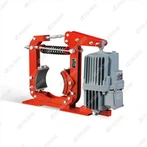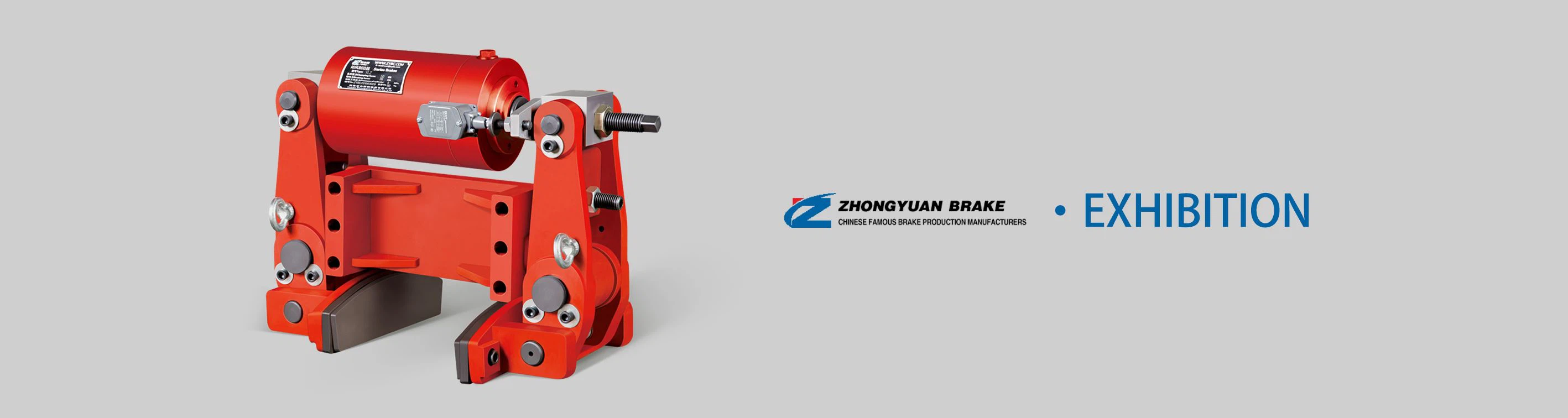
The brake of the double-beam bridge crane is generally installed on the shaft of the motor to brake the operation of the motor so that its operation or the lifting mechanism can be accurately and reliably stopped at a predetermined position. It realizes mechanism braking through the principle of friction. When there is a problem with the brake, it needs to be adjusted and overhauled. The adjustment of the brake includes three aspects: adjusting the working stroke, adjusting the braking torque, and adjusting the braking gap.
Zhongyuan Brake introduces the causes of common failures of bridge crane brakes and the solutions to various failures.
1. The brake wheel cannot be braked (the heavy object slides down)
Causes:
(1) The hinge of the lever is stuck
(2) There is oil stain on the brake wheel and friction plate
(3) The electromagnet core does not have enough stroke
(4) The brake wheel or friction plate is severely worn
(5) The main spring is loose and damaged
(6) The lock nut is loose, the tie rod is loose
(7) The impeller of the hydraulic push brake does not rotate well
Solution:
(1) Clear the stuck fault
(2) Clean oil stains
(3) Adjust the brake
(4) Replace the friction plate
(5) Replace the friction plate
(6) Tighten the lock nut
(7) Overhaul the drive mechanism and electrical parts
2. The brake is not released
Possible causes of failure:
(1) The solenoid coil is burned out
(2) The wire leading to the electromagnet is disconnected
(3) The friction plate is stuck on the brake wheel
(4) The living hinge is stuck
(5) The main spring force is too large or the counterweight is too large
(6) The brake ejector rod is bent and the electromagnet cannot be pushed (on the hydraulic push rod brake)
(7) Improper use of oil
(8) The impeller is stuck
(9) The voltage is lower than 85% of the rated voltage, and the electromagnet is insufficient
The solution to the failure:
(1) Replace
(2) Connect the line
(3) Wash with kerosene
(4) Eliminate jamming and lubricate
(5) Adjust the main spring force
(6) Straighten the ejector rod or replace the ejector rod
(7) Change the oil according to the working environment temperature
(8) Adjust the push rod mechanism and check the electrical part
(9) Find out the cause of voltage drop and troubleshoot
3. The brake heats up, the friction plate emits a burnt smell and wears quickly
Possible causes of failure:
(1) After the brake shoe is released, it is not evenly disengaged from the brake wheel, resulting in friction
(2) The gap between the two brake shoes and the brake wheel is uneven, or the gap is too small
(3) The auxiliary spring of the short-stroke brake is damaged or bent
(4) The working surface of the brake wheel is rough
The solution to the failure:
(1) Adjust the gap
(2) Adjust the gap
(3) Replace or repair auxiliary spring
(4) Turn the brake wheel surface as required
4. The brake is easy to leave the adjustment position, and the braking torque is not stable enough
Possible causes of failure:
(1) The adjusting nut and back nut are not tightened
(2) Thread damage
The solution to the failure:
(1) Tighten the nut
(2) Replace
5. The electromagnet generates heat or makes a noise
Possible causes of failure:
(1) The main spring force is too large
(2) The lever system is stuck
(3) The position of the armature and the iron core is not correct
The solution to the failure:
(1) Adjust to a suitable size
(2) Eliminate the cause of jamming and lubricate
(3) Scrape the bonding surface