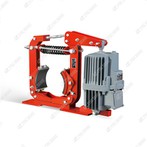
The DYW250-400 is a specialized industrial explosion-protected drum brake, engineered to deliver safe, reliable braking performance in hazardous environments where flammable gases, vapors, or dust may be present (e.g., oil & gas fields, chemical plants, coal mines). Its design integrates explosion-proof protection with robust drum braking functionality, ensuring compliance with strict safety standards while meeting the demands of heavy-duty load control. Below is a detailed breakdown of its model interpretation, core design, working principle, key features, applications, and technical specifications:
1. Model Interpretation: DYW250-400
The model code follows industry-specific naming conventions for explosion-protected drum brakes, with each segment indicating critical technical and functional parameters:
D: Abbreviation for "Drum" (denoting the brake's drum-style braking structure, where friction acts on the inner or outer surface of a rotating drum).
Y: Stands for "Hydraulic" (signifying the brake uses hydraulic actuation to drive braking engagement/release, ensuring smooth, adjustable force).
W: Represents "Explosion-Protected" (highlighting the brake's core safety feature-designated to prevent ignition of hazardous atmospheres).
250: Nominal diameter of the brake drum (in millimeters). This means the brake is specifically designed to match rotating drums with a 250mm outer diameter, a key dimension that directly influences braking torque and compatibility with driven equipment.
400: Refers to the maximum allowable rotational speed of the brake drum (in revolutions per minute, RPM). It indicates the brake can safely operate with drums rotating up to 400 RPM without compromising braking efficiency or structural integrity.
2. Core Design & Explosion-Protection Mechanism
The DYW250-400's design prioritizes both braking performance and explosion safety, with three critical subsystems:
2.1 Explosion-Protected Enclosure & Components
Explosion-Proof Rating: Typically certified to global standards such as Ex d IIB T4 Ga (for gas environments) or Ex tD A21 IP65 T135°C (for dust environments)-ensuring it can contain internal sparks, arcs, or high temperatures that could ignite external hazardous substances.
Reinforced Housing: The brake's outer casing and internal electrical/hydraulic compartments are made of thick-walled cast aluminum alloy or stainless steel (304/316 for corrosion resistance). All joints use flameproof "flame paths" (precision-machined mating surfaces with controlled gaps ≤ 0.15mm) to cool and quench any internal flames before they escape.
Sealed Electrical Connections: All wiring, sensors, and hydraulic control valves are housed in explosion-proof junction boxes with threaded, flameproof entries. Cables use explosion-proof glands to prevent gas/dust ingress.
2.2 Braking Subsystem
Brake Drum Interface: A precision-machined mounting flange designed to align with 250mm-diameter drums (attached to the rotating shaft of equipment like winches or conveyors). The interface ensures concentricity between the drum and brake shoes, avoiding uneven wear or vibration.
Friction Pair (Shoes & Linings): Two arcuate brake shoes (high-strength steel) lined with anti-static, low-spark friction material (e.g., copper-free resin-based composites). These linings minimize spark generation during braking and resist high temperatures (up to 350°C) to prevent thermal ignition risks.
Hydraulic Actuation Unit: A sealed hydraulic cylinder (isolated from the hazardous atmosphere) that drives brake engagement. It is connected to a remote hydraulic power unit (HPU) or an integrated electro-hydraulic thruster (also explosion-protected) to control pressure and force.
2.3 Safety & Control Components
Fail-Safe Spring Mechanism: High-tension return springs ensure the brake automatically engages if hydraulic pressure drops (e.g., power failure or HPU malfunction). This locks the drum in place, preventing load slippage or equipment runaway in hazardous areas.
Wear Sensors: Explosion-proof proximity sensors monitor friction lining wear. When linings reach a critical thickness (typically 3-5mm), the sensor triggers an alarm to prompt maintenance-avoiding metal-to-metal contact (a spark hazard) and extending drum life.
3. Working Principle
The DYW250-400 operates via a hydraulic actuation cycle, with safety as the central priority:
Brake Release (Normal Operation):
The brake receives a signal from the equipment's control system (e.g., a winch needing to lift a load).
The explosion-protected hydraulic unit (or thruster) increases pressure in the brake's hydraulic cylinder.
Hydraulic force pushes a piston and push rod, overcoming the tension of the return springs.
The push rod separates the two brake shoes, creating a small gap (0.3-0.5mm) between the friction linings and the 250mm drum. The drum (and connected shaft) rotates freely, allowing equipment operation.
Brake Engagement (Deceleration/Stopping):
To slow or stop the equipment, the hydraulic unit reduces pressure. The return springs regain tension and pull the brake shoes inward.
The friction linings press tightly against the rotating drum, generating braking torque (typically 300-500 N·m for this model).
Friction decelerates the drum, bringing it to a stop within a controlled time (≤ 1.0 second at 400 RPM under rated load)-with no sparks or excessive heat.
Emergency Braking (Power/Hydraulic Failure):
In case of power loss, hydraulic leak, or HPU failure, pressure drops instantly. The return springs fully engage the brake shoes within milliseconds.
The drum is locked, holding the load securely. This "fail-safe" action eliminates ignition risks and prevents accidents in hazardous zones.
4. Key Features & Advantages
Rigorous Explosion Protection: Complies with international standards (e.g., ATEX, IECEx, GB 3836) for use in Zone 1/2 (gas) and Zone 21/22 (dust) hazardous areas-critical for industries with flammable substances.
High Torque Stability: Hydraulic actuation delivers consistent braking torque (±5% of rated value) even under voltage fluctuations or temperature changes (-30°C to 70°C), ensuring predictable performance.
Low Maintenance: The sealed hydraulic system and wear-resistant friction linings (service life ≥ 6,000 hours) reduce maintenance frequency. Explosion-proof components are designed for easy inspection without compromising safety.
Anti-Corrosion Performance: Stainless steel or epoxy-coated housings resist chemical corrosion (e.g., in chemical plants) or saltwater (offshore oil platforms), extending the brake's service life.
Compatibility: Standardized mounting dimensions allow retrofitting to existing explosion-protected equipment (e.g., winches, conveyors, or mixers) with 250mm drums and ≤400 RPM operation.
5. Typical Applications
The DYW250-400 is purpose-built for hazardous industrial environments requiring explosion safety, including:
Oil & Gas Industry: Braking for offshore drilling winches, pipeline construction equipment, or refinery conveyors (where flammable hydrocarbons are present).
Chemical & Pharmaceutical Plants: Used with mixers, agitators, or material-handling cranes in zones with flammable solvents (e.g., ethanol, acetone) or toxic vapors.
Coal Mining & Mineral Processing: Braking for underground conveyor belts, mine hoists, or crusher drives (to prevent dust explosions from coal or mineral dust).
Paint & Coating Facilities: Applied to spray booth cranes or material lifts, where solvent vapors create explosive atmospheres.
6. Technical Specifications (Typical Ratings)
| Parameter | Specification (DYW250-400) |
|---|---|
| Brake Drum Diameter | 250 mm |
| Maximum Drum Speed | 400 RPM |
| Rated Braking Torque | 350-450 N·m (adjustable) |
| Explosion-Protection Rating | Ex d IIB T4 Ga / Ex tD A21 IP65 T135°C |
| Actuation Type | Hydraulic (with explosion-protected HPU/thruster) |
| Operating Temperature Range | -30°C to 70°C |
| Friction Lining Material | Anti-static resin-based composite |
| Protection Class (Enclosure) | IP66 |
| Weight | ~45-55 kg |
| Mounting Type | Flange-mounted |