
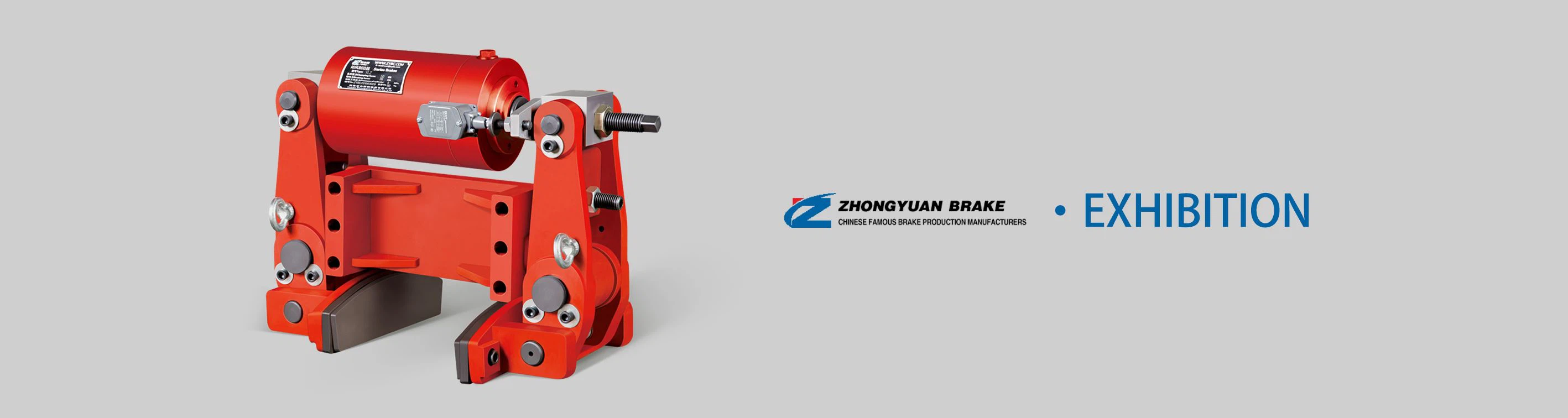
Maintenance Guide for YWZ9-300/E50 Electro-Hydraulic Drum Brakes
Proper maintenance of the YWZ9-300/E50 ensures long service life, stable braking performance, and operational safety. Below is a structured maintenance plan covering daily checks, periodic maintenance, key component care, and troubleshooting:
1. Daily Maintenance (Before & After Operation)
Focus on quick inspections to identify obvious issues and prevent failure during operation:
Check for oil leakage in the E50 thruster, hydraulic hoses, and connections. Wipe up any leakage immediately and tighten loose fittings; replace damaged seals/hoses if needed.
Inspect the brake body, lever mechanism, and mounting bolts for looseness, deformation, or corrosion. Retighten bolts to the specified torque (220–250 N·m for M16, 350–400 N·m for M20) if loose.
Verify smooth brake engagement and release. Ensure no abnormal noise (e.g., squealing, grinding) or jamming during action; check that the thruster push rod extends/retracts linearly.
Monitor the brake drum's surface for wear, scratches, or overheating (discoloration indicates overheating). Clean dust/debris on the drum and linings with a dry brush (avoid water or oil).
2. Periodic Maintenance (Classified by Cycle)
2.1 Weekly Maintenance
Measure the brake clearance (between friction linings and drum) with a caliper. The normal clearance is 0.3–0.5 mm; use the automatic wear compensator to adjust if it exceeds 1 mm.
Inspect the friction linings for wear. Replace linings if the remaining thickness is ≤5 mm (minimum wear limit) or if there are cracks, oil contamination, or uneven wear.
Lubricate the lever hinges, pivot points, and thruster push rod with high-temperature grease (operating temperature: -20°C to 200°C) to reduce friction and prevent seizing.
2.2 Monthly Maintenance
Check the E50 thruster's hydraulic oil level via the sight glass. Top up with ISO VG46 anti-wear hydraulic oil if the level is below the "MIN" mark; replace oil if it appears cloudy, discolored, or contains impurities.
Inspect the thruster's motor and electrical connections. Ensure the wiring is tight and insulated, and the thermal protector (155°C trigger) is functional. Clean dust on the motor housing to avoid overheating.
Verify the disc springs' elasticity. Replace springs if they show deformation, fatigue cracks, or fail to rebound fully (affects braking torque).
2.3 Quarterly Maintenance
Clean the brake drum's surface with fine sandpaper to remove rust, glazing, or friction debris. Check for drum deformation (end runout ≤±0.3 mm, radial runout ≤±0.2 mm); replace the drum if deformation exceeds limits.
Inspect hydraulic hoses for aging, cracking, or bulging. Replace hoses that have been in use for more than 2 years or show signs of damage (burst pressure ≥45 MPa required).
Test the braking torque with a torque meter. Adjust the E50 thruster's hydraulic pressure (12–16 MPa) if the torque is outside the 2000–3150 N·m range.
2.4 Annual Maintenance (Comprehensive Overhaul)
Drain the thruster's hydraulic oil completely, clean the oil tank and filter (10 μm precision), and refill with new ISO VG46 oil. Replace the oil filter element if it is clogged or contaminated.
Disassemble the brake body to inspect internal components: replace worn FKM seals, check lever mechanism for bending, and verify the automatic wear compensator's functionality.
Conduct a full safety test: simulate power failure to confirm emergency braking within ≤0.5 seconds, test the PLC interlock system (if equipped), and ensure limit switches (release/wear) work normally.
3. Key Component Maintenance Focus
3.1 Friction Linings
Avoid oil or grease contamination (reduces friction coefficient); clean immediately if contaminated, and replace if absorption occurs.
Replace linings in pairs to ensure uniform braking force; torque the lining fixing bolts to 15–20 N·m.
3.2 E50 Electro-Hydraulic Thruster
Do not overload the thruster (rated thrust: 50 kN, stroke: 50 mm). Check the relief valve (max pressure ≤18 MPa) to prevent hydraulic system overpressure.
Clean the thruster's air filter regularly to ensure proper ventilation; replace the filter if clogged.
3.3 Brake Drum
Avoid prolonged high-temperature operation (max surface temperature ≤200°C) to prevent drum warping.
Store spare drums in a dry environment to avoid rust; install with proper centering (deviation ≤±3 mm relative to the brake center).


