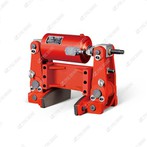
Various adjustments are mainly carried out during initial assembly (before use) and after replacing a new friction pad. During the first installation, please make adjustments in the following order.
Adjustment of pad retraction and clamping force: the size of brake pad retraction (the gap between brake pad and wheel braking surface in released state) will directly affect the size of brake clamping force, which must be adjusted to the specified rated value before use. There is a one-to-one correspondence between the pad retraction and x value and clamping force. First, observe whether the size X of the brake in the closed state meets the provisions of table 3-2. If not, please adjust according to the following methods: first open the brake (at any time, there are two methods to open the brake: A. power on the hydraulic station to provide pressure oil to open the brake; B. operate the manual hydraulic pump Open the brake (in the hydraulic station) (please refer to the manual of the supporting hydraulic station for relevant instructions); then loosen the locknut (Part 1, see Figure 3-3). When the adjusting nut (Part 2) is rotated towards the brake arm, the x value (retraction) decreases and the clamping force increases, and vice versa Increase and the clamping force decreases. Close the brake after adjustment once and observe the x value. If it does not meet the requirements, open the brake for adjustment again and again until it meets the requirements. Tighten the lock nut after adjustment.
|
Model |
Rated retraction distance each on each side (mm)) |
corresponding X (mm) |
|
YLZ25 - □ |
2 |
1 0 - 0 5 |
|
YLZ40 - □ |
2 |
1 0 - 0.5 |
|
YLZ63 - □ |
2 |
0 0 - 0.5 |
|
YLZ100 - □ |
2 |
0 0 - 0.5 |
Note: the cylinder barrel near the oil port of the hydraulic cylinder is pasted with the indication labels of the measured parts and measured values (as shown in the figure below). Please pay attention to reference when adjusting!

b. Adjustment of pad follow-up: tension spring type automatic pad follow-up device is set on the two pads of the brake (see Fig. 3)-
3) Before installing the brake, loosen the follow-up set screw (Part 10) to make the follow-up spring (Part 11) loose; After installing the brake, tighten the follow-up set screw (Part 10) when the brake is clamped. During normal operation, the follow-up spring generally does not need to be adjusted. If the follow-up is found to be abnormal during operation, it may be that the follow-up spring (Part 11) of the follow-up device is loose. As long as the follow-up spring is reinstalled or replaced, and adjusted according to the above methods.
c. Adjustment of equal setback: the brake needs to be adjusted during initial installation or after the brake pad is worn. adjustment
First release the brake to the normal release state, and observe whether the clearance between the brake pads on both sides and the wheel rim is consistent. If not, adjust the setback adjustment device (Part 8, see Figure 3-3) to make it equal. The adjustment method is as follows: first loosen the lock nuts (Part 7, both sides) of the back distance adjustment devices on both sides, and then screw the adjustment bolts on the side with larger back distance inward (Note: there should be a gap between the adjustment bolts on the other side with smaller back distance and the side wall of the base. If there is no gap, screw the screws on this side out of sufficient gap first) until the back distances on both sides are basically equal (target side) Then screw the adjusting screw on the side with smaller retreat until the distance between it and the side wall of the base is 0.2 ~ 0.5mm, and finally back tighten the locking nuts on both sides.

|
B Direction (2:1, Limited Switch) |
||
|
Brake to close |
Brake to open |
A Direction Clockwise |

Lock nut 2. Adjusting nut 3. One way throttle valve (optional) 4. Limit switch 5. One way throttle valve adjusting knob 6. Limit switch push rod 7. Back distance lock nut 8. Back distance adjusting screw 9. Follow-up fixing clip 10. Follow-up locking screw 11. Follow-up spring 12. Frame
Figure 3-3
d. Adjustment of closing time: when the brake cylinder is equipped with a one-way throttle valve to control the closing time, it needs to be adjusted. Generally, the brake can be closed only after the mechanism stops running completely. The closing time of the brake can be adjusted within the range of 0.3s to 30s. The adjustment method is: turn the adjustment knob of the one-way throttle valve (Part 5, see Fig. 3-3) inward to prolong the braking time, otherwise shorten it.
e. Adjustment of release limit switch: each brake is equipped with a travel switch indicating brake release signal. After all the above adjustments are completed, the travel switch shall be adjusted. The method is as follows (see Fig. 3-3): make the brake closed, loosen the set screw of the rotating arm, adjust the position of the rotating arm of the limit switch (Part 4), make the rotating arm drum contact with the inclined surface of the top rod (Part 6) of the limit switch, and then release and tighten the set screw of the rotating arm; Release the brake so that the switch contact can send a signal when the tile reaches the rated retraction; Repeat the closing and releasing actions of the brake for many times. After the switch signal is stable, tighten the lock nut of the top rod of the limit switch.