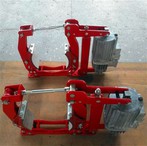
Working Principle
- When the operator steps on the foot pedal, the actuation mechanism is activated. In a mechanical setup, the force applied to the pedal is multiplied through a series of levers and linkage rods. This increased force is then used to push the brake shoes outward against the inner surface of the rotating brake drum. The friction between the brake lining on the shoes and the drum surface creates a resistive force, which slows down and eventually stops the rotation of the drum and the connected wheel or shaft.
- In a hydraulic version, the force on the pedal displaces hydraulic fluid from a master cylinder. The pressurized fluid travels through hydraulic lines to slave cylinders located near the brake shoes. The pressure in the slave cylinders pushes pistons, which in turn force the brake shoes against the drum. The hydraulic system offers the advantage of more precise force transmission and the ability to handle higher braking forces with relatively less pedal effort.