
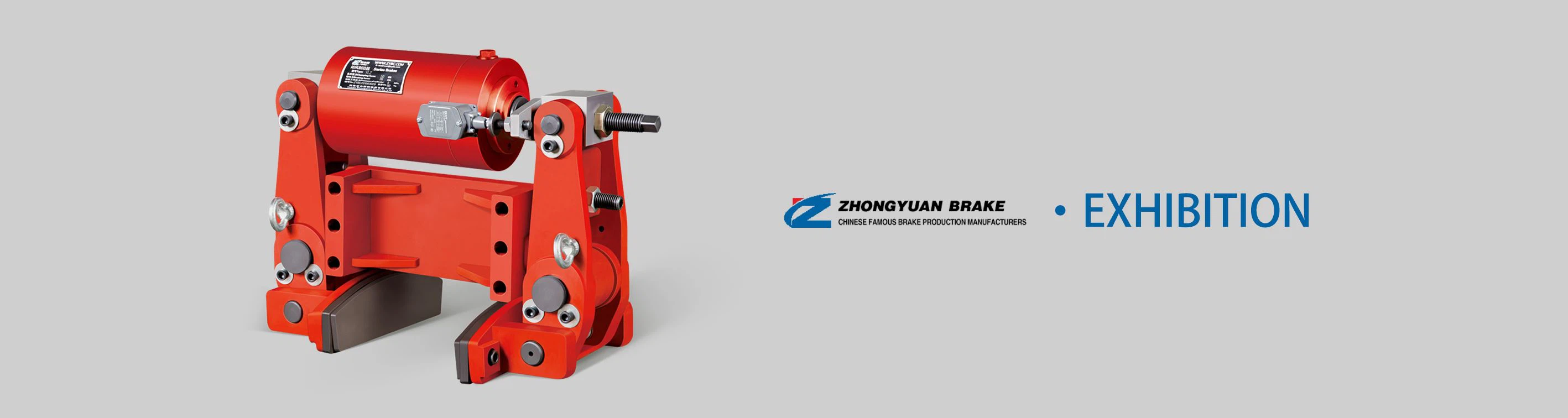
The DLZ100 series power-driven wheel brake (a normally closed, disc-spring-braked, electric-release wind-resistant brake) has typical faults concentrated in its electric drive system, braking force transmission mechanism, and safety interlock components. Below are its common fault phenomena, root causes, and distinguishing features, sorted by failure frequency (from high to low):
1. Failure to Release (Most Frequent)
Fault Phenomenon: The friction lining cannot separate from the wheel end face; the crane traveling mechanism cannot start; the limit switch has no release-in-place signal.
Root Causes:
Electric system failure: Motor power shortage, electromagnet coil burnout, or control relay stuck (failing to switch the motor to electromagnet holding mode).
Mechanical jamming: Disc springs stuck due to dust accumulation, piston guide sleeve jamming, or equal-retraction mechanism failure.
Circuit fault: Loose wiring of the motor/electromagnet, or limit switch actuator misalignment.
Distinguishing Feature: The motor may buzz but not rotate, or rotate but fail to maintain the released state (electromagnet holding failure).
2. Weak Braking Force (High Risk)
Fault Phenomenon: The brake cannot prevent the crane from being displaced by strong winds; the wheel slips under wind load; the friction lining shows uneven wear.
Root Causes:
Lining issues: Friction lining worn to ≤3 mm, or oil/dust contamination on the lining/wheel surface.
Spring fatigue: Disc springs lose preload due to long-term compression.
Clearance imbalance: The equal-retraction mechanism fails, leading to uneven clearance between the lining and wheel (one side drags, the other is too loose).
Distinguishing Feature: The brake can clamp the wheel but cannot provide the rated 135–150 kN static friction force; the lining may have glazing (oil contamination) or deep grooves (sand wear).
3. Motor Overheating During Release
Fault Phenomenon: The release motor becomes hot to the touch (surface temperature >80°C) ; the motor trips due to overcurrent; the insulation layer of the motor wire ages quickly.
Root Causes:
Control logic failure: The motor does not stop after the brake is released, and runs continuously (instead of switching to electromagnet holding).
Voltage abnormality: Power supply voltage is too high or too low (deviating from ±5% of the rated value).
Mechanical resistance: Motor bearing wear or jamming, increasing load current.
Distinguishing Feature: The motor overheats only during the release stage; if the electromagnet holding function is normal, the motor temperature drops quickly after stopping.
4. Limit Switch Failure (Common Safety Hazard)
Fault Phenomenon: No interlock signal; the crane can start even when the brake is not released, or cannot start even when released; false alarm of release failure.
Root Causes:
Environmental corrosion: Salt fog or moisture causes poor contact of switch contacts (for outdoor port applications).
Mechanical damage: Actuator bending or switch shell cracking due to vibration.
Wiring fault: Loose or broken signal wires.
Distinguishing Feature: The switch indicator light is off or flickering; the control system shows a "brake not released" fault even when the lining is separated.
5. Abnormal Noise/Vibration During Braking/Release
Fault Phenomenon: Grinding, squealing, or clunking noise; obvious vibration of the brake body during action.
Root Causes:
Loose fasteners: Mounting bolts or connecting rod pins are loose (M16 bolts loose from the rated 80–100 N·m torque).
Lining/wheel deformation: Uneven lining wear or wheel end face runout >0.1 mm.
Spring resonance: Disc springs resonate with the brake body during compression/release.
Distinguishing Feature: The noise disappears after tightening bolts or replacing the lining; resonance noise is accompanied by a specific frequency vibration.
6. Manual Release Failure (Maintenance-Related)
Fault Phenomenon: The manual release lever cannot be pulled, or pulled but cannot lift the wedge; the brake cannot be released for maintenance when power is off.
Root Causes:
Lever jamming: Rust on the lever pivot or connecting rod bending.
Mechanical resistance: Disc springs are stuck, or the equal-retraction mechanism is locked.
Distinguishing Feature: The lever feels stiff when pulled; no obvious movement of the lining when the lever is operated.
7. Electromagnet Holding Failure
Fault Phenomenon: The brake can be released by the motor but cannot maintain the released state; the motor restarts frequently to compensate for the holding force.
Root Causes:
Electromagnet coil burnout or insufficient holding current.
Air gap between the electromagnet armature and core is too large (exceeding the rated 0.2–0.5 mm).
Distinguishing Feature: The brake releases immediately after the motor stops; the electromagnet has no suction force when powered on.
Key Notes
Most faults of the DLZ100 series are related to its electric-mechanical integrated design (e.g., motor-electromagnet switching failure, limit switch interlock fault).
For coastal port applications, corrosion-related faults (limit switch contact corrosion, fastener rust) are more frequent; regular anti-corrosion maintenance is required.
Unlike hydraulic brakes, it has no oil leakage faults, making it more suitable for environmentally sensitive areas.


