
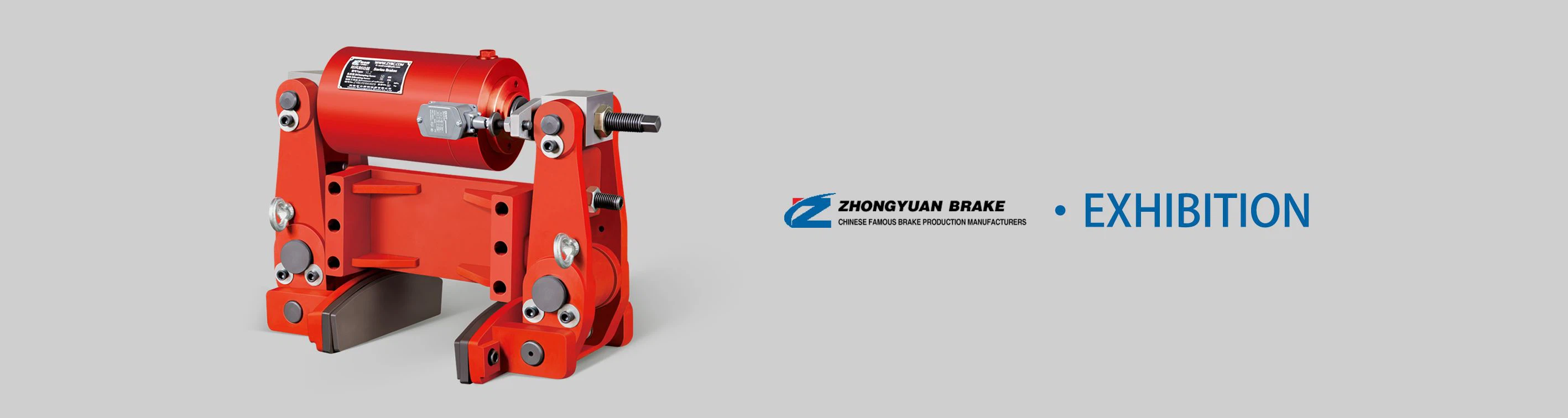
A brake that brakes by pressing the brake block against the brake wheel. The pressure of a single brake block on the brake wheel shaft is large and uneven, so a pair of brake blocks are usually used to offset the pressure of the brake block on the brake wheel shaft.
Block brake has two types: external holding type and internal tensioning type.
① External block brake: it is divided into short stroke block brake and long stroke block brake according to the length of the stroke of the control device. The magnet of the short travel block brake is mounted directly on the brake arm. When working, the moving iron core rotates around the pin shaft to realize the loosening of the brake; When the magnet is powered off, the main spring is used to tighten the brake. This kind of brake has compact structure, fast action of tight and loose brake, but large impact force. The long-travel block brake can produce large brake force through the brake lever system, but the braking action is slow, which is suitable for large brakes.
② Internal tension block brake: the brake block is located in the inside of the brake wheel, through the pedal, pull rod and convex block to open the brake block, press the inside of the brake wheel and tighten the brake, and release the pedal the spring pulls back the brake block and loosens the brake. The brake can also be operated hydraulically or pneumatic. The internal tension-type block brake has compact structure, good dust resistance, and can be used in the occasions where the installation space is limited, and is widely used in various vehicles.
Block brake brake tiles
This standard is applicable to external double brake.
According to the connection between the brake tile (referred to as the brake tile) and the brake liner, and the end of the brake tile reamer hole is divided into the following four types:
B1: rivet holes on the brake tile, with the bonding mode to connect the brake liner, the end of the brake tile hinge shaft hole without sinking holes;
B1C: No rivet hole on the brake tile, with bonding mode to connect the gasket, brake tile hinge shaft hole end with countersunk hole;
B2: there are rivet holes on the brake shingle, and the brake gasket is connected by riveting mode. The end of the brake shingle hinge shaft has no sinking hole;
B2C: There are rivet holes on the brake tile, and the brake liner is connected by riveting mode, and the end of the brake tile hinge shaft has countersunk holes.
Contact Us
- Wei Four Road, Weizhuang industrial Park, Changyuan District, Xinxiang City, Henan Province, China
- sales@zybc.com
- +86-373-7136666
What is a brake on a mechanical device
Sep 06, 2024
You Might Also Like


Send Inquiry