
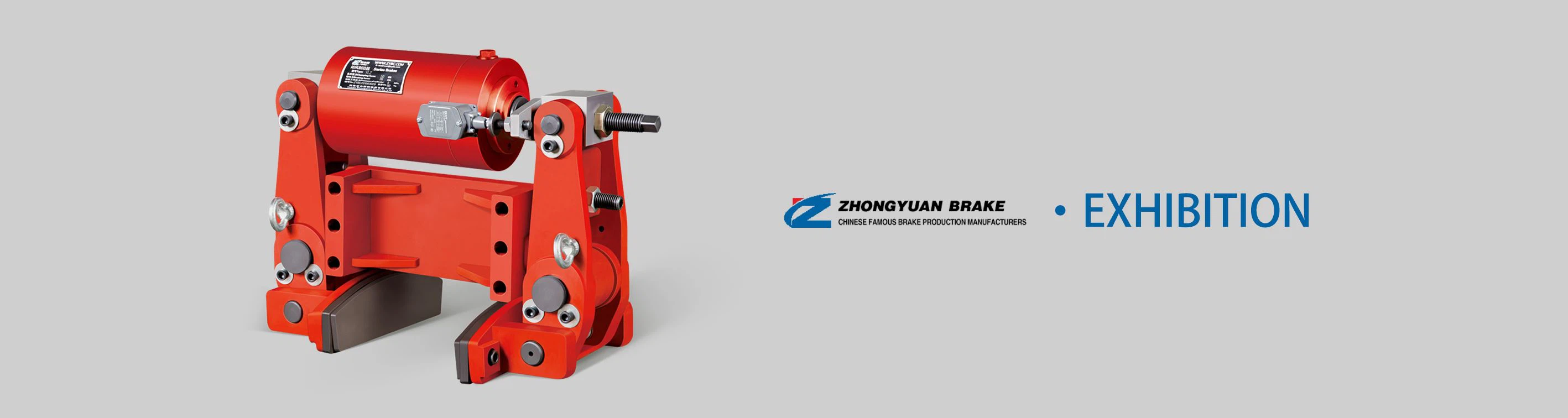
The YW-K200/E30 series normally-open electro-hydraulic drum brake is a specialized braking device designed for medium-load industrial drive systems. It exclusively pairs with the ED30/5 electro-hydraulic thruster (compliant with DIN15430 standard) and adheres to JB/T6406-2006 (connection dimensions) and DIN15435 (braking torque parameters). Its core feature of "normally open (power-off release, power-on braking)" makes it ideal for deceleration braking of large/trolley travel mechanisms in general bridge/gantry cranes and non-lifting winch drive devices, ensuring stable operation in non-explosive industrial environments.
Core Technical Specifications
| Parameter | Standard Value | Notes |
|---|---|---|
| Rated Drum Diameter | 200 mm | Matches medium-load equipment drum specifications |
| Rated Braking Torque | 224 N·m | Complies with DIN15435 standard; adjustable via thruster thrust |
| Matching Thruster Model | ED30/5 | 3-phase AC 380V/50Hz, rated thrust consistent with E30 series |
| Brake Shoe Clearance | Equal on both sides (no manual adjustment) | Maintained by interlocking clearance equalization device |
| Friction Lining Material | Optional (semi-metallic non-asbestos hard/soft, non-asbestos semi-hard) | Card-mounted integral structure for quick replacement |
| Protection Class | IP54 | Dustproof and water-resistant, adaptable to workshop humidity (≤90%) |
| Working Conditions | - Ambient Temperature: -20℃~+40℃- Altitude: ≤2000m- Duty Cycle: S3-60% (intermittent), S1 (continuous) | No flammable, explosive, or corrosive gases |
| Key Installation Dimensions (mm) | A=470, E=165, H=435, h1=170 | Standardized per JB/T6406-2006 for universal mounting |
| Weight (w/o Thruster) | ~35 kg | Compact structure for space-constrained installations |
Key Structural & Functional Features
Normally-Open Fail-Safe Design (Reverse of Conventional Brakes)Unlike common normally-closed brakes, this series is normally open when power is off: the brake shoes are separated from the drum by spring force, allowing the equipment to move freely (e.g., manual adjustment of crane position during maintenance). When power is supplied, the ED30/5 thruster drives the brake arms to clamp the drum, achieving deceleration or emergency braking-avoiding unintended braking caused by power failure and improving maintenance safety.
Interlocking Clearance Equalization & Automatic Shoe AlignmentEquipped with an interlocking clearance equalization device that dynamically adjusts the retraction distance of both brake shoes, ensuring consistent clearance on both sides without manual intervention. This completely eliminates the phenomenon of one brake pad "floating and sticking" to the drum due to uneven clearance, reducing abnormal wear of linings and drums. The automatic shoe alignment device also allows the brake shoes to adapt to minor drum runout, ensuring uniform contact and stable braking torque.
Self-Lubricating Hinges for Low MaintenanceAll main swing hinges are fitted with self-lubricating alloy bearings. During operation, the bearings form a stable oil film to reduce friction and wear, eliminating the need for regular grease filling. This not only improves transmission efficiency but also reduces maintenance workload, extending the brake's service life (average service life of hinges ≥5 years under standard working conditions).
Quick-Change Card-Mounted Friction LiningsThe friction linings adopt a card-mounted integral molding structure. Replacement only requires unlocking the lining clamp, removing the old lining, and inserting a new one-no need to disassemble the brake arms or thruster. The entire process takes ≤10 minutes, which is 60% faster than traditional bolted linings, minimizing equipment downtime. A variety of lining materials are available to match different working conditions (e.g., hard linings for high-frequency braking, soft linings for low-noise requirements).
Working Principle (Normally-Open Electro-Hydraulic Drive)
The brake operates in the "power-off release (spring-driven) + power-on braking (thruster-driven)" mode, perfectly matching the ED30/5 thruster's performance:
Power-Off Release (Equipment Idle/Maintenance)When the control system is powered off, the ED30/5 thruster loses hydraulic pressure. The brake's internal return spring drives the two brake arms to swing outward, separating the friction linings from the 200 mm-diameter drum. The equipment is in a free state, allowing for manual movement or debugging (e.g., adjusting the crane's parking position without power supply).
Power-On Braking (Equipment Deceleration/Emergency Stop)When the equipment needs to decelerate or stop, the thruster is energized. Its motor drives the centrifugal pump to pressurize hydraulic oil, pushing the push rod to extend. The push rod acts on the brake's lever mechanism, overcoming the return spring force and pulling the two brake arms to swing inward. The friction linings clamp the rotating drum tightly, converting the equipment's kinetic energy into heat (dissipated into the air) through friction. The 224 N·m rated braking torque quickly decelerates the drum, ensuring the equipment stops stably. When the equipment returns to normal operation, the thruster pressure is reduced, and the return spring pushes the brake arms outward to release the drum.
Typical Applications (Aligned with YW-K Series Scenarios)
Based on the application characteristics of YW-K series brakes (Summaries 1, 4, 5), the YW-K200/E30 is mainly used in the following scenarios:
Large/Trolley Travel Mechanisms of Bridge/Gantry Cranes
Applicable to general industrial bridge cranes, gantry cranes, and semi-gantry cranes. It provides deceleration braking for the 大车 (longitudinal travel) and trolley (transverse travel) mechanisms, ensuring smooth stopping when the crane moves to the target position. The normally-open design also allows manual adjustment of the crane's position during power failure, facilitating maintenance.
Non-Lifting Winch Drive Devices
Suitable for non-lifting winches (e.g., winches for pulling steel plates in workshops, cable traction winches in construction sites). It realizes deceleration control during the winch's traction process and emergency braking when overload or rope deviation occurs, preventing equipment damage caused by excessive speed.
Auxiliary Drive Mechanisms of Light Industrial Equipment
Used in auxiliary drive shafts of conveyors (e.g., workshop assembly line conveyors, light material transfer conveyors) and textile machinery (e.g., textile roller drives). It provides precise deceleration braking to ensure stable positioning of materials or semi-finished products, and the low-noise soft linings can be selected to meet the quiet requirements of workshop environments.


