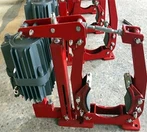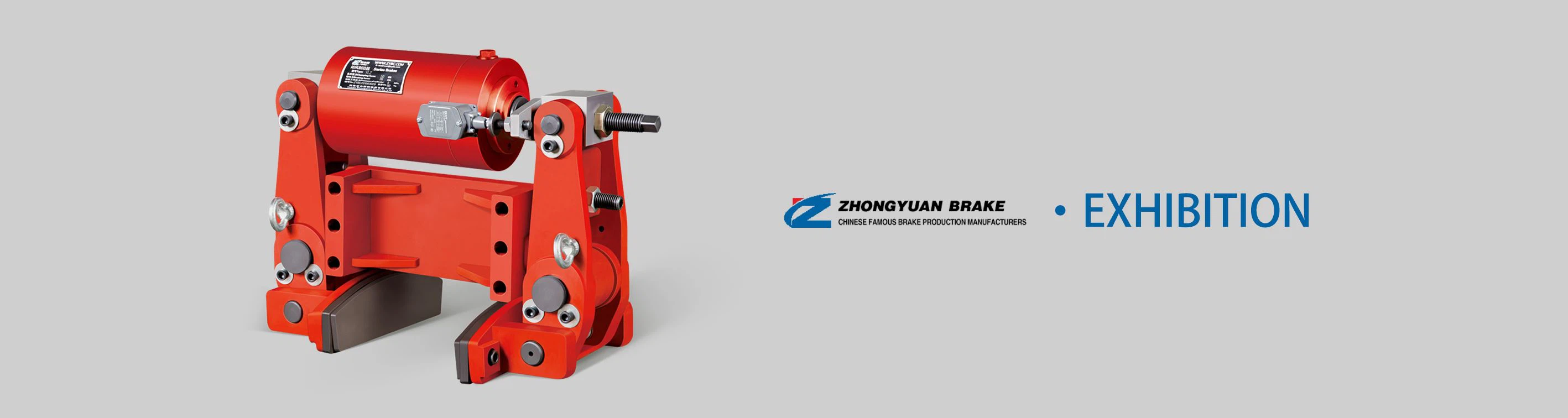
The YWZ8-315/E50A series adopts the core working mode of "electro-hydraulic release + spring braking", relying on the coordination of the matched E50A electro-hydraulic thruster and internal mechanical components to realize braking and release. Its working principle can be divided into three key links: power-on release, power-off braking, and auxiliary adaptive adjustment, which fully integrates hydraulic drive efficiency and mechanical braking reliability.
1. Power-On Release (Equipment Operation State)
When the host equipment (such as cranes, conveyors) needs to start, the control system supplies 3-phase AC 380V power to the E50A electro-hydraulic thruster. The entire release process follows a clear energy conversion and force transmission path:
Electro-Hydraulic Energy Conversion: The thruster's motor drives the internal centrifugal pump to rotate, drawing hydraulic oil from the oil tank and pressurizing it (consistent with the hydraulic system pressure-building principle in Summary 1). The high-pressure oil pushes the thruster's piston and push rod to extend linearly.
Mechanical Force Transmission: The extended push rod acts on the brake's lever mechanism (as mentioned in Summaries 2, 3, and 4). Through the lever's force-amplifying effect, it overcomes the pre-tightening force of the brake's main disc spring, driving the two brake arms to swing outward.
Brake Release Execution: The outward-swinging brake arms drive the brake shoes (with friction linings) to separate from the 315 mm-diameter brake drum. The gap between the lining and the drum is maintained at 0.8–1.2 mm (the standard clearance range of this series). At this point, the brake is fully released, and the host equipment can run normally.
2. Power-Off Braking (Equipment Stop/Emergency State)
When the equipment needs to stop or encounters a power failure, the E50A thruster loses power, and the system switches to the spring-driven braking state, ensuring fail-safe operation:
Hydraulic Pressure Disappearance: The thruster's motor stops running, the centrifugal pump ceases to build pressure, and the hydraulic pressure in the oil circuit dissipates rapidly. The thruster's push rod retracts under the reset force of its internal spring.
Spring Force Driven Braking: As the push rod retracts, the constraint on the brake's lever mechanism is removed. The pre-compressed main disc spring rebounds, generating a large clamping force and pulling the two brake arms to swing inward (consistent with the "spring force closing brake" principle in Summaries 2–4).
Friction Braking Implementation: The inward-swinging brake arms press the friction linings tightly against the inner surface of the rotating brake drum. According to the friction braking principle (Summary 5), the contact between the lining and the drum generates a tangential friction force, converting the equipment's kinetic energy into heat energy (which is dissipated into the air). This friction force forms a braking torque of 800–1600 N·m, forcing the brake drum and the connected equipment shaft to stop rotating quickly. The entire braking response time is ≤0.6 seconds, meeting emergency safety requirements.
3. Auxiliary Adaptive Adjustment Mechanism
To maintain stable braking performance during long-term use, the YWZ8-315/E50A is equipped with three key adaptive adjustment functions, which are consistent with the automatic adjustment logic of YWZ series brakes summarized in the search results:
Automatic Gap Compensation: As the friction lining wears (during repeated braking), the gap between the lining and the drum will increase beyond the standard range. At this time, the built-in mechanical gap compensator (similar to the automatic adjustment mechanism described in Summary 5) will trigger: when the brake arms swing inward during braking, the compensator's adjusting rod and ratchet mechanism engage, automatically extending the length of the brake shoe connecting rod. This resets the lining-drum gap to 0.8–1.2 mm, avoiding reduced braking torque due to excessive gaps.
Temperature Compensation: The brake's main spring and friction linings are made of temperature-resistant materials. When the ambient temperature changes (-20℃ to +50℃), the spring's elastic modulus and the lining's friction coefficient remain stable. The design of the hydraulic oil circuit also reduces the impact of temperature on oil viscosity, ensuring consistent braking force output (matching the temperature compensation mechanism in Summary 1).
Pressure Stability Assurance: Although the YWZ8-315/E50A does not have an independent pressure sensor, the E50A thruster's internal relief valve limits the maximum hydraulic pressure during release. This prevents excessive extension of the push rod and ensures that the lever mechanism and spring force are always in a balanced state, avoiding abnormal wear caused by over-force.