Latest Products


Contact Us
- Wei Four Road, Weizhuang industrial Park, Changyuan District, Xinxiang City, Henan Province, China
- sales@zybc.com
- +86-373-7136666


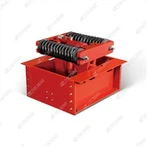
YFX-500/80 Series Electro-hydraulic Storm Braking Wedges Brakes
The YFX-500/80 series electro-hydraulic storm braking wedge brake is a normally - closed, electro - hydraulic wedge - type wind - resistant brake, mainly used for wind - proof braking of outdoor rail - mounted cranes (such as gantry cranes, quayside container cranes, and portal cranes) during...
Description
The YFX-500/80 series electro-hydraulic storm braking wedge brake is a normally - closed, electro - hydraulic wedge - type wind - resistant brake, mainly used for wind - proof braking of outdoor rail - mounted cranes (such as gantry cranes, quayside container cranes, and portal cranes) during operation and auxiliary wind - proof braking when not in operation. It is equipped with an ED80 electro - hydraulic thruster, a self - lubricating bearing, and an interlocking limit switch, featuring reliable wind - resistant performance, high safety, and low maintenance costs. Below is a detailed introduction covering core parameters, structural features, working principles, applications, maintenance, and troubleshooting.
Core Technical Parameters
| Parameter | Standard Value |
|---|---|
| Applicable wheel diameter | 500 mm |
| Rated wind - resistant force (horizontal) | 80 kN |
| Matching thruster | ED80/6 electro - hydraulic thruster (370 W, 380 V AC, 50 Hz) |
| Thruster protection class | IP65 |
| Wedge lifting stroke | 60–80 mm |
| Friction block material | High - wear - resistant alloy steel, original thickness 20 mm (replace when ≤5 mm) |
| Operating environment | -20℃ to +50℃, relative humidity ≤90%, suitable for coastal/salty - fog environments |
| Working system | S3-60%, 1200 times/hour (intermittent) |
| Interlock device | Limit switch (interlocks with the crane traveling mechanism) |
| Manual release | Equipped with a mechanical manual release lever |
| Weight | ~85–95 kg |
| Compliance standard | JB/T 10917-2008 |
Structural & Design Features
Normally - Closed Safety Design: It uses the thruster to lift the wedge for release during operation and relies on the wedge's self - weight and wind force to lower and wedge the rail for braking when power is off, preventing the crane from being displaced by strong winds.
ED - Type Electro - Hydraulic Thruster: The ED80/6 thruster has good sealing performance and a high protection level, and can be equipped with a delay - lowering function to reduce the impact of the crane on the wedge after power failure.
High - Performance Transmission Mechanism: The main swing hinge points are equipped with self - lubricating bearings and stainless - steel pins, which have high transmission efficiency and are not prone to rust or jamming.
Interlocking & Position Monitoring: The limit switch can interlock with the crane traveling mechanism to ensure that the crane can only travel when the wedge is lifted, and it can also monitor the lifting position of the wedge in real - time.
Manual Release & Easy Maintenance: It is equipped with a manual release lever for easy maintenance and emergency release; the friction block can be replaced quickly without disassembling the entire brake.
Corrosion - Resistant Design: Fasteners and pins adopt QPQ surface treatment or stainless - steel materials, and the friction block has good corrosion resistance, suitable for coastal port environments.
Working Principle
It works in the mode of electro - hydraulic lifting for release and self - weight/wind - force lowering for braking:
Release (Operation State): When the crane is ready to travel, the ED80 thruster is activated, and its push rod lifts the wedge via the connecting rod and lever, separating it from the rail, allowing the crane to move normally.
Braking (Stopped/Wind - Proof State): When the crane stops or the power is cut off, the thruster loses power, and the wedge lowers under its own weight and is wedged between the wheel and the rail. When the crane is moved by strong winds, the wheel presses against the wedge, achieving wind - resistant braking.
Interlock Protection: The limit switch sends a signal when the wedge is fully lifted, and the crane traveling mechanism can be started only after receiving the signal, preventing misoperation.
Emergency Release: When the thruster fails, the manual release lever can be used to lift the wedge for emergency movement or maintenance.
Typical Applications
It is mainly installed at both ends of the crane traveling trolley, suitable for wind - proof braking of outdoor rail - mounted cranes in ports, wharves, and railways during operation. It can also work with anchoring devices and wind - resistant cables to provide double safety protection for cranes when they are not in operation. It is especially suitable for cranes with a rated load below 45 t.
Maintenance Guidelines
1. Daily Inspection (5-10 Minutes/Shift)
Mechanical: Check if the wedge is firmly wedged when braking, if the friction block is intact and free of oil/dirt, and if the connecting rod and hinge are flexible.
Electrical & Hydraulic: Inspect the thruster for oil leakage, abnormal noise, and intact cables; check if the limit switch is working normally and if the wiring is tight.
Interlock Test: Confirm that the crane cannot travel when the wedge is not lifted to avoid safety accidents.
2. Periodic Maintenance Schedule
| Cycle | Core Tasks | Details & Standards |
|---|---|---|
| 1 Month | Friction Block & Wedge Inspection | Check the friction block thickness; replace it if ≤5 mm. Inspect the wedge surface for cracks and repair or replace it if necessary. |
| 3 Months | Thruster & Lubrication | Check the thruster oil level and top up with ISO VG 46 hydraulic oil if needed. Lubricate the manual release lever pivot with lithium - based grease. |
| 6 Months | Seal & Fastener Overhaul | Replace the thruster seals and damaged hydraulic hoses. Re - tighten the mounting bolts (60-80 N·m for M12 bolts) and check the stainless - steel pins for rust. |
| 12 Months | Limit Switch & Performance Test | Replace the aging limit switch. Conduct a wind - load simulation test to ensure that the wedge can reliably wedge the rail and the braking force meets the requirements. |
Common Faults & Fixes
| Fault | Possible Cause | Solution |
|---|---|---|
| Wedge fails to lift | Faulty thruster, stuck connecting rod, or insufficient oil in the thruster | Repair/replace the thruster; lubricate the connecting rod; add hydraulic oil. |
| Weak wind - resistant braking | Worn friction block, loose wedge, or dirty rail surface | Replace the friction block; adjust the wedge position; clean the rail surface. |
| Limit switch failure | Poor contact or damaged switch | Re - wire the switch; replace the faulty limit switch. |
| Thruster oil leakage | Damaged seals or loose joints | Replace the seals; re - tighten the joints. |
Post - Maintenance Verification
Action Test: Ensure that the wedge lifts/releases smoothly, and the interlock with the traveling mechanism is reliable.
Static Wedging Test: After lowering the wedge, apply a horizontal force equivalent to 1.2 times the rated wind - resistant force to confirm no displacement.
Emergency Test: Use the manual release lever to lift the wedge and confirm that it can be released normally for emergency movement.
Hot Tags: yfx-500/80 series electro-hydraulic storm braking wedges brakes, China, manufacturers, supplier, factory, customized
You Might Also Like