
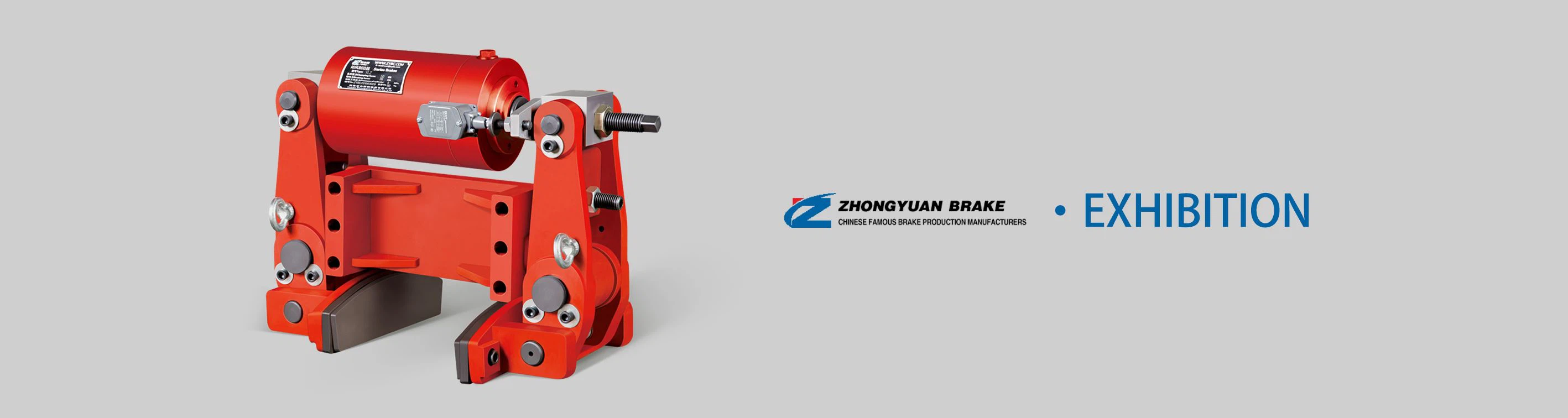
QW series pneumatic drum brakes QW315-50 are mainly composed of a brake frame, a pneumatic actuator, and a matched thruster. Its working principle and application are as follows:
Working Principle
QW315-50 pneumatic drum brakes adopt a normally-closed design, that is, spring braking and air pressure release. The specific working process is as follows:
Brake Engagement: In the normal state, the brake is in a braking state. At this time, there is no compressed air entering the brake cylinder, and the spring inside the brake cylinder exerts force to make the brake shoes tightly press against the inner wall of the brake drum. This is because the spring force pushes the piston in the brake cylinder, and the piston drives the brake shoes to move outward, so that the friction lining on the brake shoes is in close contact with the brake drum. The friction between the two generates a braking torque, which slows down or stops the rotating parts connected to the brake drum.
Brake Release: When the equipment needs to operate, compressed air is supplied to the brake cylinder through the air pipeline. The pressure of the compressed air acts on the piston in the brake cylinder, overcoming the force of the spring and pushing the piston to move in the opposite direction. The piston drives the brake shoes to move inward, so that there is a gap between the brake shoes and the brake drum, and the brake is released. At this time, the rotating parts connected to the brake drum can rotate freely.
Brake Reset: When the equipment needs to stop again, the air source is cut off, and the compressed air in the brake cylinder is discharged. The spring inside the brake cylinder restores its original state, and the spring force pushes the piston and the brake shoes to move outward again, so that the brake shoes are tightly pressed against the inner wall of the brake drum, and the brake is reset to the braking state.
Applications
QW315-50 pneumatic drum brakes can be widely used in various mechanical mechanisms with on-site air sources, such as lifting, belt transportation, port loading and unloading, and metallurgical machinery for deceleration and parking braking. For example, in cranes, it can be used to brake the hoisting mechanism and the running mechanism to ensure the safe operation of the crane; in belt conveyors, it can be used to stop the belt quickly when the conveyor stops or malfunctions to prevent the belt from slipping or running out of control.


