
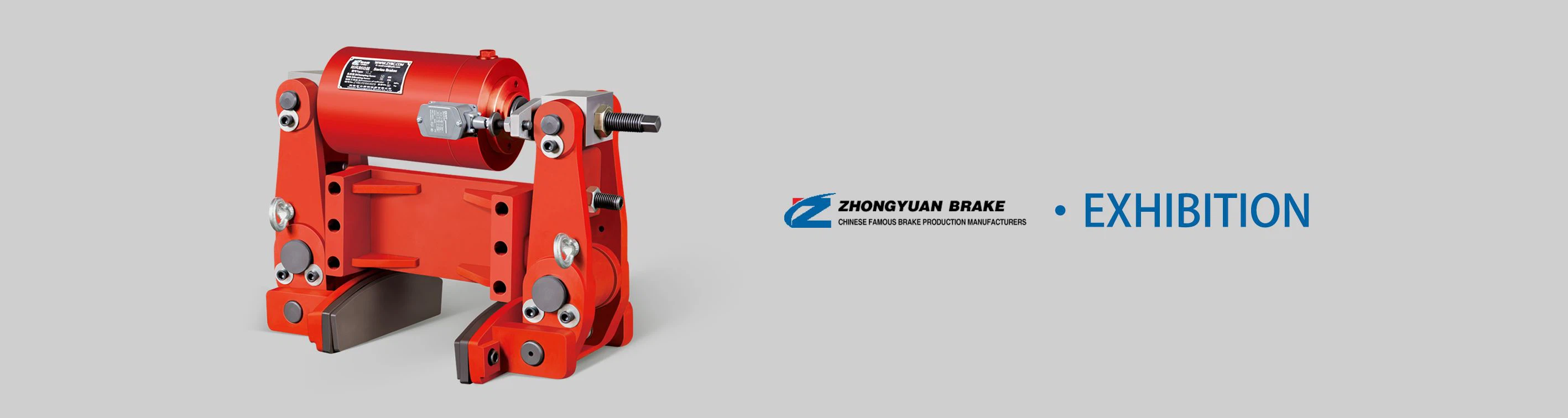
The SBD-A Series and ST3SH Safety Brake are two specialized, industrial-grade safety braking solutions engineered primarily for crane applications (e.g., overhead cranes, gantry cranes, tower cranes) and other heavy-duty rotating machinery. Both are designed with fail-safe functionality as their core-prioritizing load holding, emergency stopping, and overspeed protection to prevent accidents in high-load, high-risk industrial environments. While sharing a focus on crane safety, each series features unique design attributes tailored to specific operational needs (e.g., torque range, installation space, environmental resilience). Below is a detailed breakdown of their core definitions, working principles, key features, crane-specific adaptations, and typical applications:
1. Core Definitions & Functional Roles
Both brakes serve as critical "safety-critical components" for cranes, but their design orientations differ slightly:
1.1 SBD-A Series Safety Brake
A spring-applied, hydraulically/pneumatically released disc-type safety brake. It is a versatile, medium-to-high torque brake designed for general crane safety tasks-including emergency stopping of hoisting mechanisms, holding loads during static suspension (e.g., when a crane pauses mid-lift), and preventing shaft rotation during maintenance. Its disc-based design ensures uniform braking force and compatibility with a wide range of crane drive shaft sizes.
1.2 ST3SH Safety Brake
A spring-actuated, mechanically or hydraulically released drum or disc-type safety brake (typically drum-based for crane applications). It is a compact, high-reliability brake optimized for crane travel mechanisms (e.g., trolley travel, bridge travel) and small-to-medium hoisting units. Its "SH" suffix often denotes "short-stroke" or "high-sensitivity"-features that enable fast response times for dynamic braking during crane movement.
2. Working Principle (Shared Fail-Safe Design)
Both the SBD-A Series and ST3SH Safety Brake operate on a fail-safe principle (spring-engaged, pressure/force-released)-ensuring braking capability is maintained even if the primary power or actuation source fails. Their working cycles follow three key states:
2.1 1. Brake Release (Normal Crane Operation)
SBD-A Series: When the crane's hoisting/travel mechanism is activated, hydraulic or pneumatic pressure is supplied to the brake's cylinder. This pressure compresses internal high-tension springs, retracting the brake calipers (disc-type) to create a small gap (0.2-0.4mm) between the friction pads and the rotating disc. The disc (connected to the crane's drive shaft) rotates freely, allowing smooth lifting, lowering, or traversing.
ST3SH Safety Brake: For crane travel/hoisting, a mechanical linkage (e.g., from the crane's control lever) or hydraulic force overcomes the spring tension. This pulls the brake shoes (drum-type) away from the brake drum, releasing the shaft for rotation.
2.2 2. Brake Engagement (Emergency Stopping/Load Holding)
Emergency Stopping: If the crane exceeds safe speed (detected by an overspeed switch) or a critical fault occurs (e.g., power loss, control system failure), the brake's actuation pressure/force is cut off. Compressed springs expand instantly, pushing the SBD-A's pads against the disc or the ST3SH's shoes against the drum. Friction generates braking torque, decelerating the shaft to a stop within 0.5-1.0 seconds (depending on model).
Load Holding: When the crane suspends a load (e.g., mid-air), the control system reduces actuation pressure/force. Springs partially engage the brake, applying just enough torque to hold the load securely-preventing slippage even if the primary drive system fails.
2.3 3. Manual Release (Maintenance)
Both brakes include a manual release mechanism (e.g., handwheel for SBD-A, release lever for ST3SH). This allows operators to retract the brake manually during maintenance (e.g., replacing friction components), enabling safe rotation of the crane's shaft without activating the main actuation system.
3. Key Features (Series-Specific Attributes)
While both brakes prioritize safety, their design features are optimized for different crane use cases:
3.1 SBD-A Series Safety Brake
Disc-Type Braking for Uniform Force: Uses a dual-caliper or single-caliper design with high-quality friction pads (semi-metallic or ceramic composites). The disc ensures even contact and heat dissipation-critical for frequent braking in heavy hoisting (e.g., 20-100 ton cranes).
Adjustable Torque Range: Spring preload can be adjusted to deliver 100-5,000 N·m of braking torque, adapting to small hoists (e.g., 5-ton) and large gantry cranes (e.g., 200-ton).
Environmental Resilience: Housings made of cast iron (HT300) with anti-corrosion epoxy coatings; seals use FKM (fluoropolymer) for resistance to dust, moisture, and high temperatures (-30°C to 100°C)-suitable for outdoor or harsh-industry cranes (e.g., steel mills, ports).
Wear Monitoring: Optional proximity sensors detect pad wear, triggering an alarm when pads reach minimum thickness (prevents metal-to-metal contact and disc damage).
3.2 ST3SH Safety Brake
Compact Drum-Type Design: Small form factor makes it ideal for crane travel mechanisms (e.g., trolley wheels) or space-constrained hoisting units (e.g., jib cranes). Its drum structure simplifies installation and reduces weight (typically 5-15 kg, vs. 15-40 kg for SBD-A).
High Sensitivity & Fast Response: "Short-stroke" actuation ensures engagement within 0.3-0.6 seconds-critical for dynamic braking during crane travel (e.g., stopping a moving trolley to avoid collisions).
Mechanical Backup: In addition to spring actuation, some models include a mechanical locking pin for long-term load holding (e.g., when the crane is idle for extended periods), adding an extra layer of safety.
Low Maintenance: Replaceable brake shoes with a service life of ≥ 6,000 working hours; no hydraulic fluid required (for mechanical-release models), reducing leakage risks in overhead crane applications.
4. Crane-Specific Adaptations
Both brakes are engineered to address the unique challenges of crane operation:
Vibration Resistance: Internal components (e.g., springs, pistons) are secured with anti-loosening fasteners to withstand the vibration of moving cranes (e.g., bridge cranes traversing rails).
Overload Protection: Braking torque is calibrated to exceed the crane's maximum load torque by 1.5-2 times, ensuring safe stopping even if the crane is overloaded (within design limits).
Mounting Compatibility: Standardized flange or bracket mounts align with crane drive shaft interfaces (e.g., ISO 7425 for hoisting mechanisms), enabling direct retrofitting to most crane models (e.g., Konecranes, Demag).
Temperature Management: SBD-A's disc design and ST3SH's vented drum dissipate heat from frequent braking (e.g., during repeated lifting/lowering), preventing brake fade (loss of friction due to overheating).
5. Typical Applications
While both are crane-focused, their use cases are differentiated by crane type and function:
5.1 SBD-A Series Safety Brake
Heavy-Duty Cranes: Overhead cranes, gantry cranes, and shipyard cranes (hoisting mechanisms for steel coils, containers, or ship components).
Mining & Construction Cranes: Tower cranes and crawler cranes (load holding during high-wind conditions or emergency shutdowns).
Industrial Cranes: Steel mill cranes (resisting high temperatures and dust) and port container cranes (withstanding saltwater corrosion).
5.2 ST3SH Safety Brake
Light-to-Medium Cranes: Jib cranes, workstation cranes, and small overhead cranes (travel mechanisms for trolley or bridge movement).
Mobile Cranes: Truck-mounted cranes (compact design fits in limited space) and mini crawler cranes (mechanical release for remote operation).
Auxiliary Crane Systems: Conveyor cranes (for material feeding) and maintenance cranes (load holding during equipment repairs).
6. Technical Specifications (Typical Ratings)
| Parameter | SBD-A Series | ST3SH Safety Brake |
|---|---|---|
| Braking Type | Disc-type | Drum-type (primary) |
| Actuation Mode | Spring-applied, hydraulic/pneumatic release | Spring-applied, mechanical/hydraulic release |
| Braking Torque Range | 100-5,000 N·m | 50-1,200 N·m |
| Compatibility | Disc diameter: 180-800 mm | Drum diameter: 120-300 mm |
| Operating Temperature | -30°C to 100°C | -20°C to 80°C |
| Protection Class | IP65 (standard) / IP67 (optional) | IP64 (standard) |
| Weight Range | 15-40 kg | 5-15 kg |
| Friction Material Life | ≥ 8,000 hours | ≥ 6,000 hours |


