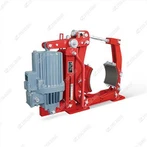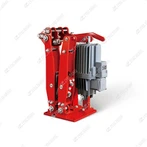
The TJ2 - 300/300 Series Electromagnetic Drum Brake combines the advantages of electromagnetic control and drum - type structure. When compared with pneumatic brakes, hydraulic brakes, electromagnetic disc brakes, and other common brake types, it shows obvious advantages in safety, control performance, maintenance, and cost. The specific advantages are as follows:
Compared with pneumatic brakes (such as CQPD - 35B series pneumatic disc brakes)
Higher safety and more reliable power failure protection: It adopts a normally - closed design. When the power is cut off due to a fault, the compressed main spring can immediately drive the brake shoes to clamp the brake drum to achieve braking. This is crucial for lifting and mining equipment that requires high safety, as it can prevent accidents such as heavy objects falling. In contrast, most pneumatic brakes rely on air pressure to realize braking or release. Once the air source fails or the pipeline is blocked, the braking function may fail, and additional emergency protection devices are often needed.
More precise braking force adjustment: The braking force of this series of brakes can be accurately adjusted by changing the current of the electromagnet. It can achieve stepless adjustment of the braking torque according to the load and speed of the equipment, which is suitable for scenarios requiring stable braking such as material lifting and lowering in metallurgical workshops. Pneumatic brakes adjust the braking force by changing the air pressure. However, affected by factors such as air source pressure fluctuations and pipeline resistance, it is difficult to achieve high - precision control of the braking force.
Compared with hydraulic brakes
No leakage risk and more environmental protection: It has no complex hydraulic pipelines, oil tanks, or other components. Thus, it avoids the problems of environmental pollution and reduced braking efficiency caused by hydraulic oil leakage, which often occur in hydraulic brakes. It is more in line with the environmental requirements of modern industrial sites. Meanwhile, it also reduces the maintenance work such as regular oil replacement and pipeline inspection required for hydraulic brakes.
Faster response and no temperature - induced performance degradation: It relies on the rapid generation and disappearance of electromagnetic force to drive the brake action, with a millisecond - level response speed. In contrast, hydraulic brakes are affected by the viscosity change of hydraulic oil due to temperature. In low - temperature environments, the oil viscosity increases, slowing down the braking response. In high - temperature environments, the oil may become thin, leading to unstable braking performance. The TJ2 - 300/300 can work stably within the temperature range of - 20°C ~ + 50°C without being troubled by such problems.
Compared with electromagnetic disc brakes
Stronger adaptability to harsh environments such as dust: The drum - type structure can form a relatively closed space for the brake shoes and brake drum. It can effectively prevent dust, gravel, and other debris from adhering to the friction surface, which is very suitable for dusty working conditions such as mining areas and construction sites. The friction surface of electromagnetic disc brakes is usually exposed. Once dust accumulates, the braking effect will be significantly reduced, and the wear of the brake disc will be accelerated, requiring frequent cleaning and maintenance.
Lower manufacturing and use costs: The drum - type structure of the TJ2 - 300/300 is mature in technology and simple in processing. The matching brake shoes and brake drums have low production costs. The electromagnetic disc brake has higher requirements for the flatness and wear resistance of the brake disc. The manufacturing and processing costs of its components are higher. Moreover, the exposed brake disc of the electromagnetic disc brake is more prone to deformation due to collision during use, which increases the later replacement cost.
Compared with mechanical brakes
Easier to realize automatic and long - distance control: It can be connected with the electrical control system of the equipment. Through electrical signals, it can realize automatic braking and release according to the operating state of the equipment, which is convenient for integrating into automated production lines and intelligent mechanical systems. Mechanical brakes usually require manual operation or linkage with complex mechanical mechanisms to achieve braking, which is not only labor - intensive but also difficult to realize automatic control and long - distance operation.
More stable braking performance and less manual intervention: The braking torque of this series of brakes is stable, and the electromagnetic drive method can avoid the problem of unstable braking force caused by manual operation errors or mechanical wear in mechanical brakes. In addition, it is equipped with an adjusting rod that can adjust the gap between the brake shoes and the brake drum. After the brake lining is worn, it can be quickly adjusted without frequent manual calibration like mechanical brakes to ensure braking performance.