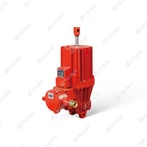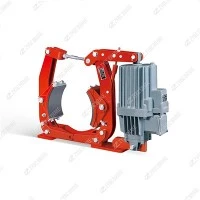
1. Model Interpretation & Core Function
The YP1-800-450×20's model code directly reflects its structural configuration, performance parameters, and disc compatibility, enabling quick equipment matching:
| Model Segment | Meaning |
|---|---|
| YP | Electro-Hydraulic Disc Brake Series (spring-engaged, electro-hydraulic released) |
| 1 | Single-caliper configuration (one caliper for braking action) |
| 800 | Nominal braking torque: 800 kN·m (for heavy-duty high-torque scenarios) |
| 450 | Compatible brake disc diameter: 450 mm (optimized for torque distribution) |
| 20 | Compatible brake disc thickness: 20 mm (high-strength alloy steel, wear-resistant) |
Its core functions target safety-critical heavy-duty scenarios requiring ultra-high reliability:
High-Torque Braking: Delivers stable 800 kN·m torque to decelerate or stop large rotating machinery (e.g., mine hoists, port cranes) smoothly, avoiding structural shock.
Emergency Stopping: Rapidly engages in power loss, electro-hydraulic system failure, or overspeed (≥110% of rated speed) to prevent machinery runaway and catastrophic accidents.
Static Load Holding: Secures extra-heavy loads (e.g., 100-ton containers, hoisted ore batches) during downtime, maintenance, or power outages-ensuring zero accidental movement.
Continuous Operation Adaptability: Withstands high-frequency braking cycles (S3-80% duty cycle) without thermal fading, suitable for 24/7 industrial workflows.
2. Working Principle
The YP1-800-450×20 operates on a fail-safe principle (spring force for braking, electro-hydraulic thrust for release), with optimized force transmission for heavy-duty torque output. Its working cycle includes three key states:
2.1 Brake Engagement (Safety State: Default)
When the machinery is stationary, in emergency, or powered off, internal high-tension disc springs (60Si2MnA alloy steel) expand outward.
The spring force pushes the single-caliper's dual-sided friction pads to clamp tightly against the rotating brake disc (450 mm diameter, 20 mm thickness).
Friction between the pads and disc generates 800 kN·m of stable braking torque, resisting the disc's rotation to stop the connected machinery shaft or hold it stationary.
2.2 Brake Release (Operating State)
When the machinery needs to run, the matched electro-hydraulic actuator (integrated with the caliper) is activated. It converts electrical energy into hydraulic pressure (18–25 MPa), generating linear thrust to overcome the disc spring force.
The thrust retracts the caliper's piston and friction pads, creating a precise 0.5–1.0 mm clearance between the pads and disc.
The brake disc rotates freely with the machinery shaft, enabling normal operation (e.g., crane hoisting, conveyor movement).
2.3 Emergency Response (Fault State)
In case of power loss, hydraulic leakage, or emergency shutdown signals, the electro-hydraulic actuator's pressure dissipates instantly.
The disc springs rebound within ≤0.25 seconds, driving the friction pads to re-clamp the disc-engaging full braking torque to stop the machinery immediately and eliminate safety hazards.
3. Core Structure & Key Components
The YP1-800-450×20 features a robust, heavy-duty design with five critical subsystems, optimized for high torque, durability, and harsh-environment adaptability:
3.1 Single Caliper Assembly (Friction Core)
Reinforced Caliper Body: Cast steel (QT600-3) caliper with thickened walls (25–30 mm) to resist deformation under high clamping force (400–500 kN). The single-caliper design balances torque output and installation space efficiency.
Dual-Sided Friction Pads: Ceramic-metallic composite pads with a friction coefficient (μ ≥ 0.48) and heat resistance up to 650°C. Each pad is 18 mm thick, bolted with quick-release fasteners for replacement (≤30 minutes per set).
Automatic Wear Adjuster: Precision mechanical adjuster that compensates for pad wear (up to 15 mm), maintaining consistent brake clearance without manual calibration-critical for continuous operation.
3.2 Disc Spring Mechanism (Safety Core)
High-Strength Spring Stack: 60Si2MnA alloy steel disc springs arranged in parallel, providing total clamping force of 400–500 kN. The stack is coated with anti-corrosion and anti-fatigue layers to extend service life in humid/dusty environments.
Guided Spring Sleeve: Wear-resistant alloy steel sleeve that ensures uniform spring expansion/contraction, avoiding jamming and ensuring reliable engagement.
3.3 Electro-Hydraulic Actuator (Power Core)
Integrated Actuator: Mounted directly on the caliper, integrating a three-phase AC motor (380V/50Hz, power: 5.5 kW), high-pressure hydraulic pump, and sealed cylinder. It delivers 18–25 MPa hydraulic pressure to release the brake.
FKM Seals: Fluororubber seals resist high pressure, oil aging, and temperature fluctuations, ensuring leak-free operation in extreme conditions.
Manual Release Valve: A mechanical valve for manual pressure relief during power loss, enabling maintenance or emergency reset.
3.4 Safety & Control Components (Control Core)
Dual Limit Switches: Position sensors (one for "fully engaged," one for "fully released") with IP65 protection, sending digital signals to the machinery's PLC for interlock control (machinery starts only when brake is released).
Multi-Parameter Sensors: Built-in wear sensors (trigger alerts when pad thickness ≤3 mm), temperature sensors (monitor disc temperature ≤600°C), and hydraulic pressure sensors (detect abnormal pressure drops).
Emergency Stop Interface: Compatible with industrial emergency stop systems, enabling instant brake engagement upon signal input.
3.5 Mounting & Protection Components (Durability Core)
Reinforced Mounting Bracket: High-strength steel bracket with ±15 mm horizontal/vertical adjustment, adapting to machinery vibration and misalignment.
IP66 Protection Cover: Sealed steel cover with double-layer waterproof and dustproof design, shielding internal components from heavy dust, water immersion (short-term), and mechanical impact.
Anti-Corrosion Coating: Double-layer epoxy resin coating (120–150 μm) on calipers and brackets, resisting mine water, salt spray, and industrial chemicals.