
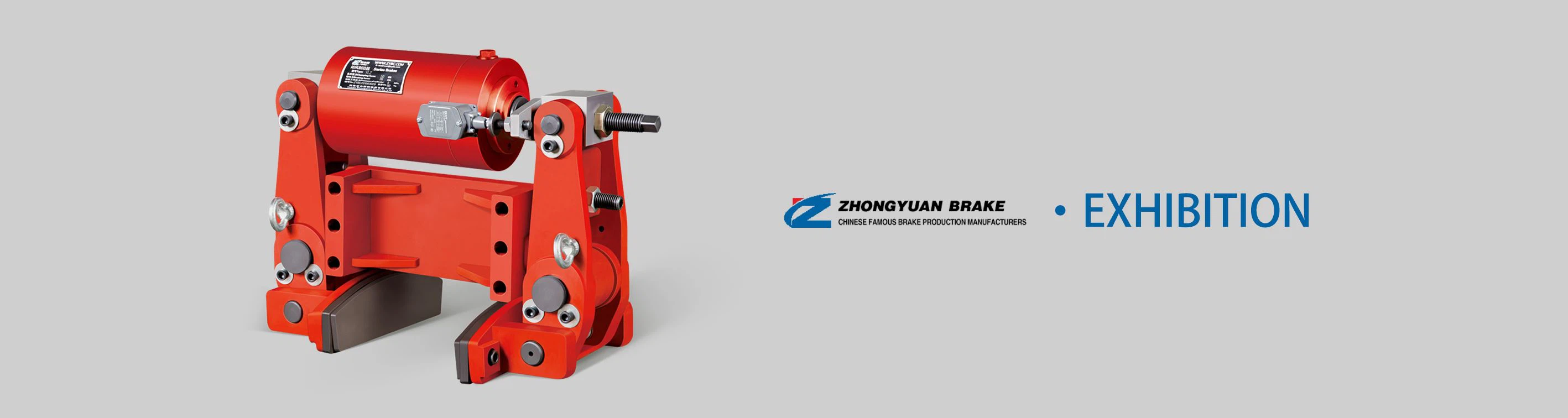
1. Core Definition & Core Functions
The YW-K series' "normally-open" design is its defining characteristic, targeting scenarios where the brake remains disengaged by default and only activates when braking is required. Its core functions address industrial needs for active, precise braking control:
Core Functions
Active Electro-Hydraulic Braking: Braking is initiated only when an electrical signal is received, with adjustable hydraulic force to achieve smooth deceleration or emergency stopping.
Spring-Assisted Release: Automatically returns to the normally open state when power is cut off, ensuring the machinery can operate freely without drag resistance during normal operation.
Equal Clearance Maintenance: Equipped with an interlocking clearance equalization device to keep both brake shoes aligned, avoiding uneven wear and ensuring stable braking performance.
Emergency Braking: Supports quick response to emergency shutdown signals, engaging braking force instantly to prevent machinery runaway.
2. Working Principle
The YW-K series operates on an electro-hydraulic activated (braking) + spring released (normally open) principle, with precise force control and clearance equalization mechanisms. Its working cycle includes three key states:
2.1 Normally Open State (Default/Operating State)
When the machinery is running and no braking signal is received, the brake is in its default normally open state.
Internal return springs expand to push the brake shoes inward, creating a 0.5–0.8 mm clearance between the friction pads and the brake drum.
The brake drum rotates freely with the machinery shaft, enabling unobstructed operation (e.g., crane traveling, winch lifting) without drag friction.
2.2 Braking State (Active Activation)
When braking is required (e.g., equipment shutdown, speed reduction, or emergency stop), an electrical signal is sent to the matched electro-hydraulic thruster/cylinder.
The thruster converts electrical energy into hydraulic pressure, generating linear thrust that overcomes the return spring force.
The thrust pushes the lever mechanism, driving the two brake shoes to swing outward and press the friction pads tightly against the rotating brake drum.
Friction between the pads and drum generates adjustable braking torque (model-dependent), decelerating or stopping the machinery smoothly.
2.3 Emergency Release/Reset State
When the braking signal is canceled or power is cut off, the electro-hydraulic thruster loses pressure instantly.
The internal return springs rebound, pulling the brake shoes inward to retract the friction pads from the drum-restoring the 0.5–0.8 mm clearance and returning the brake to the normally open state.
For emergency situations (e.g., thruster failure), a manual release lever allows mechanical retraction of the brake shoes to free the drum.


