
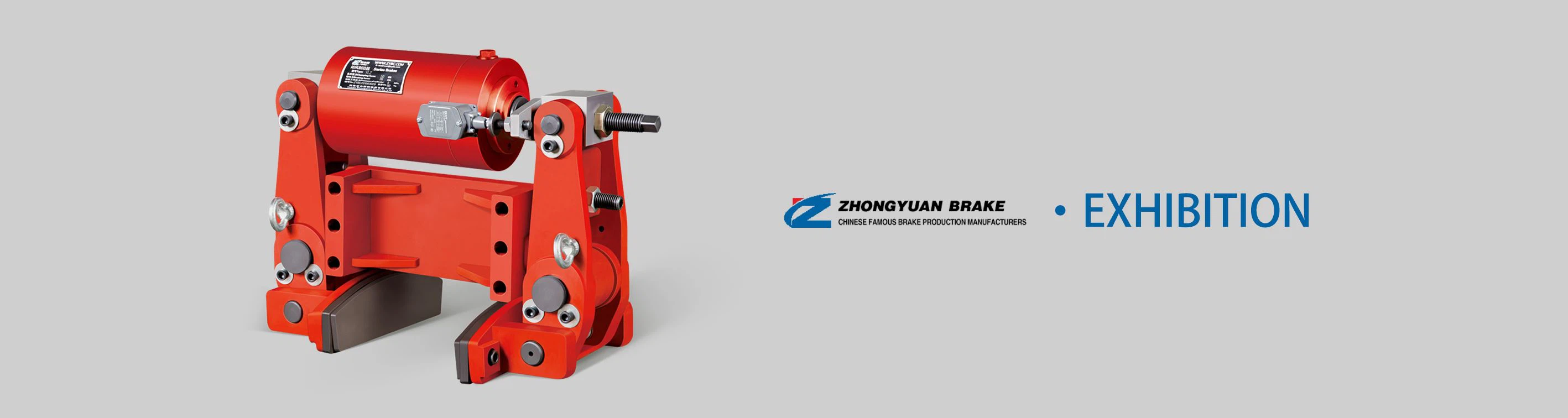
1. Core Function & "Normally-Open" Principle
The defining characteristic of the YW-K series is its Normally-Open (NO) configuration.
At Rest (Power Off): The brake is released (open). The springs hold the brake shoes away from the drum.
When Powered (Energized): The Ed201 electro-hydraulic thruster activates, compressing the release spring and forcing the brake shoes to close onto the brake wheel, applying the braking torque.
Application: This mode is typically used for holding or positioning applications where the load should be free to move unless a signal is given to stop it, or for dynamic braking during operation.
2. Key Technical Specifications
表格
| Parameter | Specification | Notes |
|---|---|---|
| Model | YW-K500/E201 | Normally-Open configuration. |
| Brake Wheel Diameter | 500 mm | Standard drum size for the "500" frame. |
| Drive Unit | Ed201/6 | Electro-hydraulic thruster. |
| Rated Thrust | 2000 N | Force generated by the Ed201 pusher. |
| Stroke | 60 mm | Standard stroke for the "/6" variant. |
| Braking Torque | Adjustable | Depends on spring force and friction material. |
| Power Supply | 380V / 660V, 50Hz | Standard industrial 3-phase power. |
3. Key Features
Open-Type Design: Specifically engineered so that the default state is "released." This is the opposite of the standard YWZ series (which are normally closed).
Ed201 Thruster: Utilizes the robust Ed201 series pusher. This provides a strong, reliable linear force to overcome the holding springs and apply the brake.
Self-Lubricating Hinges: Like other modern electro-hydraulic brakes, it features self-lubricating bushings at all major pivot points to reduce maintenance.
Equal Clearance Device: Equipped with a mechanism to ensure both brake shoes apply pressure evenly, preventing uneven wear and "dragging."
Plug-in Brake Lining: Features clip-in type brake linings for quick and easy replacement without removing the brake from the shaft.
4. Typical Applications
The YW-K500/E201 is used in scenarios where a brake needs to actively engage to stop motion rather than hold it by default:
Dynamic Braking: Used in conjunction with other drives to control speed during lowering or deceleration.
Holding Brakes: Where the mechanism needs to be free to move (e.g., under gravity or external force) but must be locked in place when a specific signal is received.
Test Benches: Used to apply load or resistance to rotating machinery during testing.
Conveyors: In specific configurations where the conveyor should coast to a stop unless an emergency stop is commanded (though normally closed is more common for E-Stop).


