
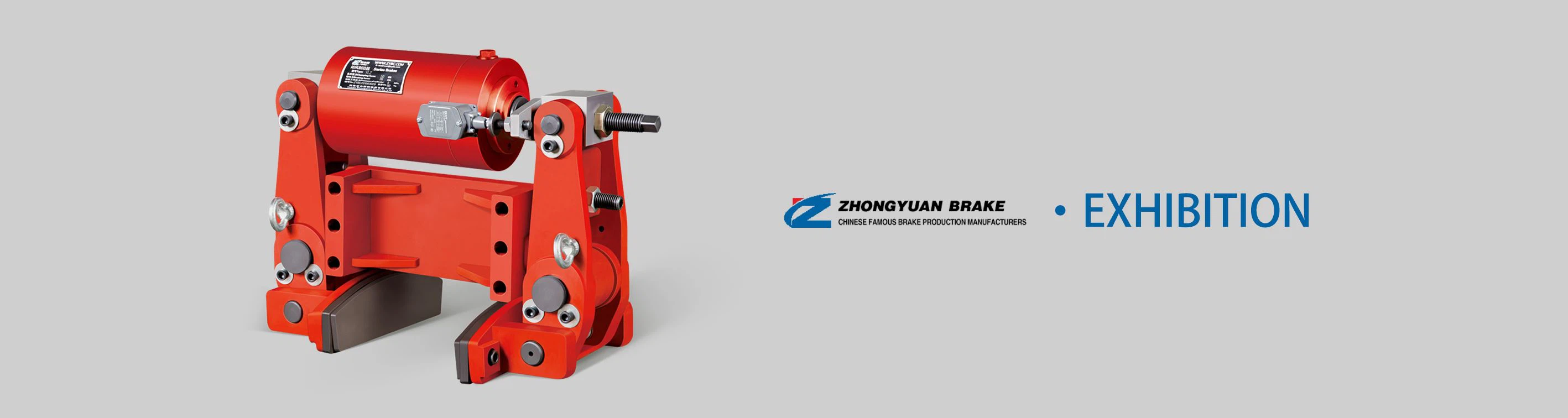
The QW250-32 is a pneumatic drum brake from the QW series, mostly manufactured by manufacturers such as Jiaozuo Jingu. It is compatible with various heavy-duty industrial equipment equipped with air sources. Its advantages focus on braking reliability, maintenance convenience, and adaptability, and it is widely used in multiple industrial scenarios such as hoisting and ports. Detailed introduction is as follows:
1. Core Advantages
1.1 Stable Braking and High Safety
Adopts a normally closed design, automatically achieving braking via springs when air supply is cut off. This effectively prevents safety accidents such as equipment sliding caused by unexpected air cut-off. Equipped with an interlocking clearance equalization device and an automatic shoe positioning device, it can always maintain consistent clearance between the shoes on both sides. This completely solves the problem of one-side brake lining adhering to the brake drum due to uneven clearance, making the braking process smoother and meeting the requirements of high-frequency braking operations. In addition, it is matched with a new-type cylinder with sensitive action response, which can quickly switch between braking and release, further improving the safety of equipment operation.
1.2 Convenient Maintenance and Low Cost
The brake lining adopts a clamped integral molding structure. When the lining is worn, it can be replaced quickly without complex disassembly. Manufacturers provide various lining materials such as semi-metallic asbestos-free hard, semi-hard, and soft asbestos-free types, facilitating users to choose according to different working conditions. All main swing hinge points are equipped with self-lubricating bearings, featuring high transmission efficiency and long service life, with no need for additional lubrication during use. Moreover, the brake spring is arranged inside the square tube, which not only prevents the spring from external pollution and damage but also allows operators to intuitively check and adjust the braking torque through the scale on the square tube, reducing the debugging difficulty during maintenance.
1.3 Strong Adaptability and Durability
The brake complies with industry standards such as JB/T 6406-2006, and can meet the installation requirements of various industrial equipment. It can work normally in an environment of -25°C to +50°C, coping with the temperature difference in most outdoor and workshop settings. Meanwhile, its structural design is simple, key components are made of durable materials, and combined with the new-type cylinder, the overall wear rate is low. It can adapt to long-term high-intensity industrial operations and reduce the frequency of equipment shutdown for maintenance.
2. Application Scenarios and Key Usage Notes
2.1 Typical Application Scenarios
Commonly used in various hoisting machinery, such as the traveling and lifting mechanisms of overhead cranes and gantry cranes, ensuring braking safety during the lifting and movement of heavy objects. Compatible with port loading and unloading equipment, such as small container lifting devices and port belt conveyors, coping with humid and salt spray-rich environments. Also applicable to metallurgical machinery, mine belt conveyors, and other equipment, adapting to working environments with high dust and frequent braking. Stable braking avoids problems such as deviation or material sliding during material transportation.
2.2 Key Usage Notes
During use, ensure stable air supply and strictly control the working air pressure within the range specified by the equipment to avoid excessive or insufficient air pressure affecting braking effect. Before restarting after long-term shutdown, check the wear of the brake lining, whether the shoe clearance is normal, and the airtightness of the cylinder to prevent failures such as air leakage and braking delay. If used in low-temperature environments, timely check for ice blockage in the air source pipeline to avoid affecting the normal ventilation and action of the braking system.


