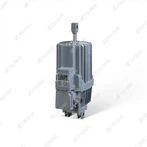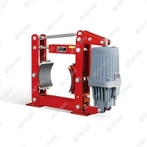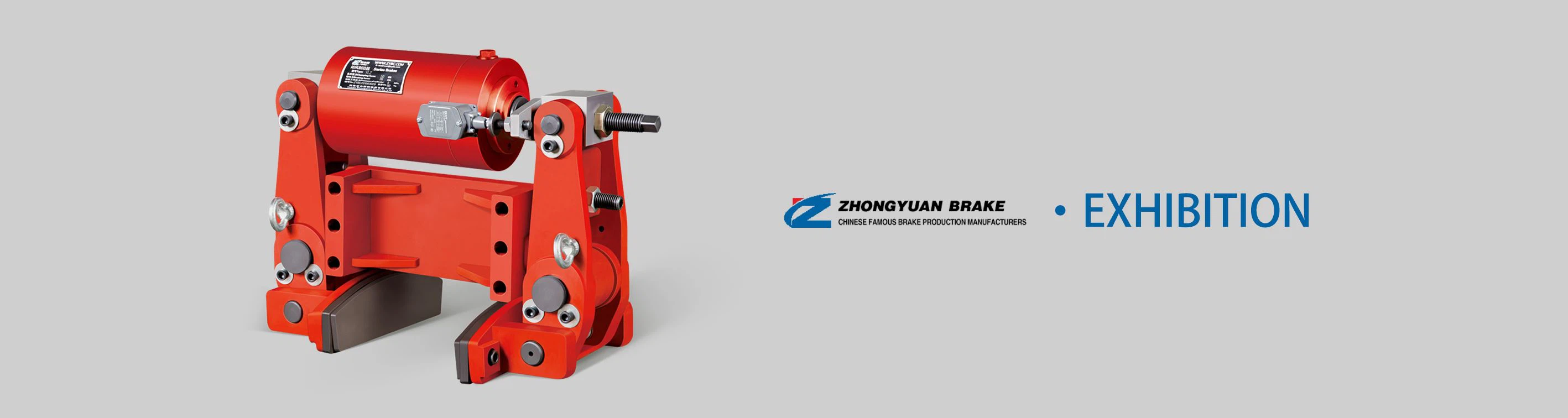
The YWZ8-200/E23 drum brake operates on a fail-safe, spring-engaged & electro-hydraulic released principle-relying on mechanical spring force for braking (ensuring safety during power loss) and hydraulic thrust from the matched E23 electro-hydraulic thruster for release (enabling normal operation). Its working cycle is divided into three core states, with optimized heat dissipation design (a key upgrade of the YWZ8 series) to handle high-frequency braking scenarios.
1. Brake Engagement (Safety State: Default for Stationary/Emergency)
This is the brake's default state when the machinery is off, in emergency mode, or loses power-prioritizing safety by automatically stopping/holding the load.
Force Source: Internal high-tension compression springs (60Si2MnA alloy steel, total clamping force 4.5–6.0 kN) expand outward.
Mechanical Transmission: The spring force pushes two arc-shaped brake shoes (Q355 steel with reinforced ribs) to swing outward.
Friction Braking: The ceramic-resin composite friction pads (attached to the shoes) press tightly against the inner wall of the rotating brake drum (200 mm diameter, HT300 cast iron).
Torque Generation: Friction between the pads and drum generates 250–400 N·m of braking torque, which resists the drum's rotation-either stopping the connected machinery shaft or holding it stationary (e.g., preventing lifted goods from falling).
2. Brake Release (Operating State: For Machinery Startup/Running)
When the machinery needs to operate, the E23 electro-hydraulic thruster provides thrust to overcome the spring force, separating the friction components to avoid drag.
Thruster Activation: The E23 thruster (0.18 kW motor, 380V AC) converts electrical energy into linear hydraulic thrust (230 N) via its internal centrifugal pump and cylinder.
Lever Mechanism Action: The thruster's thrust pulls the integrated steel lever (45# steel with reinforcing plates), compressing the internal springs inward.
Clearance Creation: The brake shoes retract, creating a precise 0.4–0.7 mm clearance between the friction pads and drum-this minimizes energy loss from drag friction (a YWZ8 series optimization for efficiency).
Free Rotation: The brake drum rotates freely with the machinery shaft, allowing normal operation (e.g., conveyor movement, winch lifting).
3. Emergency Response (Fault State: Power Loss/Thruster Failure)
The brake's core safety advantage lies in its automatic engagement during faults, eliminating the risk of machinery runaway.
Thrust Dissipation: If power is lost, the thruster leaks oil, or an emergency shutdown signal is triggered, the thruster's hydraulic thrust disappears instantly.
Spring Rebound: The compressed springs expand rapidly (within ≤0.35 seconds) to push the brake shoes outward.
Instant Braking: The friction pads re-clamp the drum, generating full braking torque to stop the machinery quickly-preventing accidents like material spillage (for conveyors) or load slippage (for winches).
Key Design Optimizations for Working Principle
Heat Dissipation Support: The brake drum's integrated radial fins and HT300 high-strength material accelerate heat release during high-frequency braking. This prevents thermal fading (a common issue in older series) and ensures stable friction performance even after repeated engagement.
Uniform Force Distribution: Symmetrically arranged springs and reinforced brake shoes ensure the friction pads press evenly against the drum-avoiding local wear and maintaining consistent braking torque (±2% of nominal value).
Self-Lubricating Hinges: The shoe hinge's brass bushings reduce friction during shoe swing, ensuring smooth engagement/release and extending the brake's service life.