Latest Products


Contact Us
- Wei Four Road, Weizhuang industrial Park, Changyuan District, Xinxiang City, Henan Province, China
- sales@zybc.com
- +86-373-7136666


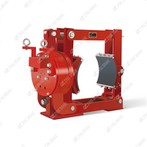
JZ300 Series Electromagnetic Drum Brakes
The JZ300 series electromagnetic drum brake is a normally-closed, spring-applied, AC electromagnetic-released heavy-duty braking device. It fully complies with JB/ZQ4388-86 (connection dimensions and braking torque parameters) and JB/T7685-2006 (technical requirements), with a rated braking...
Description
The JZ300 series electromagnetic drum brake is a normally-closed, spring-applied, AC electromagnetic-released heavy-duty braking device. It fully complies with JB/ZQ4388-86 (connection dimensions and braking torque parameters) and JB/T7685-2006 (technical requirements), with a rated braking torque matching medium-to-heavy load scenarios. Its core advantages include self-lubricating hinges, replaceable brake shoes, and reliable fail-safe performance, making it widely used in non-explosive environments such as cranes, port machinery, metallurgical equipment, mining machinery, and oilfield pumping units.
Core Technical Specifications
| Parameter | Standard Value | Notes |
|---|---|---|
| Brake Type | Normally-closed electromagnetic drum brake (spring braking, electromagnetic release) | Fail-safe: Automatic braking on power loss (critical for load safety) |
| Rated Drum Diameter | 300 mm | Matches medium-to-heavy load equipment drum specifications |
| Rated Braking Torque | 800–1200 N·m | Adjustable via spring preload; adapts to intermittent/continuous operation (JC=25%–100%) |
| Working Voltage | AC 380V/50Hz | Compatible with standard industrial power grids; no additional voltage conversion needed |
| Brake Shoe Clearance | 0.8–1.2 mm | Factory-set; ensures no friction between shoe and drum during release |
| Friction Shoe Structure | Riveted type (standard); clip-on integral type (optional) | Specify clip-on type when ordering for faster replacement |
| Swing Hinge Configuration | Self-lubricating bearings | No manual lubrication required; transmission efficiency ≥95%, service life ≥5 years |
| Protection Class | IP54 | Dustproof and water-resistant; adaptable to humid/dusty industrial environments |
| Working Conditions | - Ambient Temperature: -20℃~+40℃- Relative Humidity: ≤90%- Altitude: ≤2000m- No explosive/corrosive gases or conductive dust | Complies with general heavy-industry environment requirements |
| Key Installation Dimensions (mm) | Mounting center distance: 450; Overall length: 780; Brake shoe width: 160 | Standardized per JB/ZQ4388-86 for universal mounting |
| Weight (w/o Electromagnetic Coil) | ~65 kg | Robust structure for heavy-duty operation |
Key Structural & Functional Features
Fail-Safe Normally-Closed MechanismAdopts the core logic of "spring braking (power-off) + electromagnetic release (power-on)" (Summaries 1, 4, 6). When the electromagnetic coil is de-energized, high-strength compression springs drive the brake shoes to clamp the 300 mm drum tightly, generating 800–1200 N·m of braking torque to prevent equipment slipping or load falling. When energized, the coil generates magnetic force to pull the armature and lever mechanism, overcoming spring force and separating the shoes from the drum-ensuring smooth equipment operation.
Low-Maintenance Self-Lubricating HingesAll main swing hinges are equipped with self-lubricating alloy bearings (Summary 1). During operation, the bearings form a stable oil film to reduce friction and wear, eliminating the need for regular grease filling. This not only lowers maintenance workload but also extends the brake's service life, making it suitable for remote or hard-to-maintain scenarios (e.g., mining machinery, oilfield pumping units).
Dual-Option Friction Shoes for Versatility
Standard Riveted Shoes: Factory-equipped with riveted brake shoes (asbestos-free composite material), featuring high friction coefficient (≥0.38) and stable performance under heavy loads.
Optional Clip-On Shoes: For scenarios requiring frequent replacement (e.g., high-frequency start-stop conveyors), clip-on integral shoes can be selected. Replacement takes ≤10 minutes (no need to disassemble the brake arm), reducing downtime by 50% compared to riveted types (Summary 1).
Energy-Saving Electromagnetic ControlThe electromagnetic coil adopts a "strong current excitation + weak current maintenance" mode (Summary 6). When the brake is released, the coil first uses strong current to quickly attract the armature (≤0.3 seconds), then switches to weak current to maintain the state-reducing power consumption by ~30% compared to constant strong current designs, which is ideal for long-running equipment (e.g., belt conveyors, pumping units).
Robust Structural DesignThe brake body, lever, and base are made of high-strength Q235 steel, withstanding impact forces during emergency braking. Connections between components (e.g., lever and hinge) use high-wear shaft pins, ensuring flexible rotation without jamming even under vibration (suitable for construction machinery, port cranes).
Working Principle
The JZ300 operates based on the coordination of electromagnetic force and mechanical spring force, following three core steps (Summaries 4, 5, 6):
Power-On Release (Equipment Operation)When the control system supplies power, the electromagnetic coil first receives strong current to quickly excite and attract the armature. The armature drives the 螺杆 (screw rod) to push the brake lever, overcoming the pre-tightening force of the compression spring. This causes the two brake arms to swing outward, separating the friction shoes from the 300 mm drum (clearance 0.8–1.2 mm). The coil then switches to weak current to maintain the armature's attracted state, and the equipment runs normally.
Power-Off Braking (Stopping/Emergency)
Normal Stopping: When the equipment needs to stop, the coil power is cut off. Magnetic force disappears, and the compression spring rebounds instantly, pulling the brake lever inward. The friction shoes clamp the rotating drum, converting kinetic energy into heat (dissipated into the air) through friction-generating 800–1200 N·m of torque to decelerate the equipment smoothly.
Emergency Braking: In case of sudden power failure, the coil loses power immediately. The spring drives the shoes to clamp the drum within ≤0.5 seconds, preventing load slipping (e.g., crane hooks) or equipment runaway (e.g., oilfield pumping unit drums).
Reset & Clearance MaintenanceAfter braking, the return spring (built into the hinge) pushes the lever and armature back to the initial position, ready for the next release cycle. The factory-set shoe-drum clearance (0.8–1.2 mm) is maintained by the lever's limit structure, avoiding manual adjustment during normal use.
Typical Applications
Aligned with JZ series application scenarios (Summaries 1, 4, 5), the JZ300 is widely used in:
Lifting & Transport Machinery
Bridge cranes, gantry cranes, and jib cranes: Provides braking for lifting and travel mechanisms, ensuring stable control of heavy loads (e.g., steel plates, containers) during ascent/descent and safe parking.
Electric hoists and winches: The high braking torque (800–1200 N·m) handles load inertia during sudden stops, preventing slipping.
Port & Metallurgical Equipment
Port container cranes, bulk handlers: Adapts to dusty, humid port environments (IP54 protection) and handles high-frequency start-stop cycles during loading/unloading.
Metallurgical rolling mills, blast furnace charging machines: Withstands high ambient temperatures (-20℃~+40℃) and resists dust interference, ensuring stable braking during steel production.
Oilfield & Mining Machinery
Drum-type oilfield pumping units: The energy-saving electromagnetic design reduces long-term power consumption; the self-lubricating hinges adapt to remote oilfield maintenance conditions (Summary 4).
Mine belt conveyors, mine winders: The fail-safe design prevents conveyor reversal or winder overspeed, ensuring underground operation safety.
General Industrial Machinery
Heavy-duty belt conveyors (coal, cement): The constant braking torque avoids material "piling" during stopping; the clip-on shoes (optional) facilitate on-site maintenance.- 启闭机 (gate hoists) for water conservancy projects: The robust structure resists outdoor weathering, ensuring reliable braking for gate lifting/lowering.
Installation & Maintenance Guidelines
Installation Key Points
Drum Preparation: Ensure the 300 mm drum has surface roughness ≤Ra 1.6 μm, runout ≤0.15 mm, and no oil stains (clean with degreaser if contaminated). The drum's hardness should be ≥HB 280 to avoid excessive shoe wear.
Alignment Requirement: Align the brake's center line with the drum's axis (deviation ≤0.3 mm) using a level. The base flatness error must be ≤0.5 mm/m to prevent uneven shoe contact.
Electrical Connection: Connect the coil to AC 380V power, with a dedicated control switch (to implement strong/weak current conversion). Ensure grounding resistance ≤4 Ω and coil insulation resistance ≥1 MΩ (test with a megohmmeter).
Clearance Check: After installation, manually test the brake release/braking cycle 3–5 times. Verify the shoe-drum clearance is 0.8–1.2 mm; adjust the spring preload if torque is insufficient.
Hot Tags: jz300 series electromagnetic drum brakes, China, manufacturers, supplier, factory, customized, Safety Electromagnetic drum brake, Energy saving Electromagnetic drum brake, DC Electromagnetic drum braking, electromagnetic drum braking system, DC Electromagnetic drum brakes, DC Electromagnetic drum braking system
You Might Also Like