

Latest Products

Contact Us
- Wei Four Road, Weizhuang industrial Park, Changyuan District, Xinxiang City, Henan Province, China
- sales@zybc.com
- +86-373-7136666


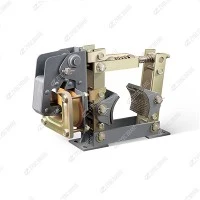
DLZ63 Series Power-driven Wheel Brakes
The DLZ63 series power-driven wheel brakes are a type of electric wheel-side brake widely used in windproof scenarios of large-scale machinery. It has the advantages of a compact structure, high safety, and strong corrosion resistance. The following is a detailed introduction to its core...
Description
The DLZ63 series power-driven wheel brakes are a type of electric wheel-side brake widely used in windproof scenarios of large-scale machinery. It has the advantages of a compact structure, high safety, and strong corrosion resistance. The following is a detailed introduction to its core information such as key parameters, working principles, installation and commissioning, and maintenance methods:
Key Parameters
| Parameter Category | Specific Content |
|---|---|
| Application Specifications | The applicable wheel diameter is 500 - 1000mm, the wheel width is 150 - 210mm, and the wheel pressure is ≤ 100T. The rated static friction force can reach 45 - 150KN, which is suitable for the windproof braking demand of large outdoor cranes. |
| Working Environment | The ambient temperature ranges from -20℃ to +50℃, the relative humidity is ≤90%, and the protection level reaches IP65. It can adapt to the harsh working environments such as port salt spray and outdoor dust. |
| Electrical Parameters | The working voltage is AC 380V - 690V, 50Hz/60Hz; the control voltage of the electromagnet is AC 220V, 50Hz. It supports continuous operation system S1 - 100% and intermittent operation S3 - 60%, with a working frequency not exceeding 400 times per hour. |
Working PrincipleThis series of brakes adopts a normally closed design, relying on disc springs to apply force for braking and electric power to open. In the non-working state, the disc spring is in a compressed state, pushing the brake mechanism to clamp the wheel to achieve braking. When the machinery needs to operate, the motor drives the ball screw through gear reduction to push the brake mechanism to separate, and the electromagnet maintains the open state to reduce energy consumption. Once the power is cut off, the electromagnet loses its magnetic force, and the disc spring rebounds rapidly to drive the brake to clamp the wheel again and automatically apply the brake, preventing the wheel from rolling and displacing due to wind force.
Installation and Commissioning
Pre-installation Preparation: First, check whether the brake housing, friction lining, motor, and other components are intact, and confirm that the fasteners and pins are not rusted. Then clean the installation position on the passive wheel of the crane to remove oil stains and rust. Prepare installation tools such as wrenches and screwdrivers, as well as auxiliary materials such as gaskets.
Positioning and Fixing: Hoist the brake to the preset position of the wheel edge, and generally install it in pairs on the passive wheel to ensure that the friction lining is aligned with the side of the wheel edge. Initially fix it with bolts without tightening. Then adjust the position to ensure that the two sides of the friction lining are parallel to the wheel edge. After the position is determined, tighten the fixing bolts. If necessary, weld the adapter plate to enhance the firmness, and pay attention to controlling the welding temperature to avoid deformation of the brake housing.
Electrical Connection: Connect the motor and electromagnet circuits of the brake to the electrical system of the host machine such as the crane, ensuring that the voltage and frequency parameters match. At the same time, connect devices such as anemometers and speed sensors to the brake control system to realize interlocking control. For example, when the wind speed exceeds the safe range, the sensor can trigger the brake to apply automatically.
Post-installation Commissioning: Check whether the brake can be opened and closed flexibly. If the opening is not in place, adjust the stroke of the ball screw. Then test the gap between the friction lining and the wheel edge, and ensure that the gap on both sides is uniform. Finally, perform multiple power - on and power - off tests. Confirm that the brake can quickly apply and release the brake when power is off and on, and verify that the interlocking function is effective.
Maintenance Methods
Daily Inspection: Regularly check the wear of the friction lining. If the lining is thinned significantly or cracked, replace it in time. Inspect the tightness of stainless steel fasteners. If there is looseness, tighten it promptly. Also, check whether the motor and electromagnet have abnormal noise or heating during operation, and troubleshoot in time if any fault occurs.
Regular Maintenance: Every 6 months, open the sealed cover to inspect the internal gear and ball screw structure, and apply lubricating oil appropriately. Check the elastic state of the disc spring. If fatigue deformation is found, replace it immediately. The friction lining should be fully inspected once a year, and the worn parts should be replaced uniformly to avoid uneven braking force caused by inconsistent wear.
Special Environment Protection: In salt - spray environments such as ports, regularly clean the brake surface with fresh water to prevent corrosion of metal parts. In low - temperature environments below -20℃, take thermal insulation measures for the electrical components of the brake to avoid poor performance caused by low temperature. When the machinery is out of service for a long time, use the manual release device to open the brake, and apply anti - rust oil to the friction surface and moving parts.
Hot Tags: dlz63 series power-driven wheel brakes, China, manufacturers, supplier, factory, customized
You Might Also Like


